Order Online
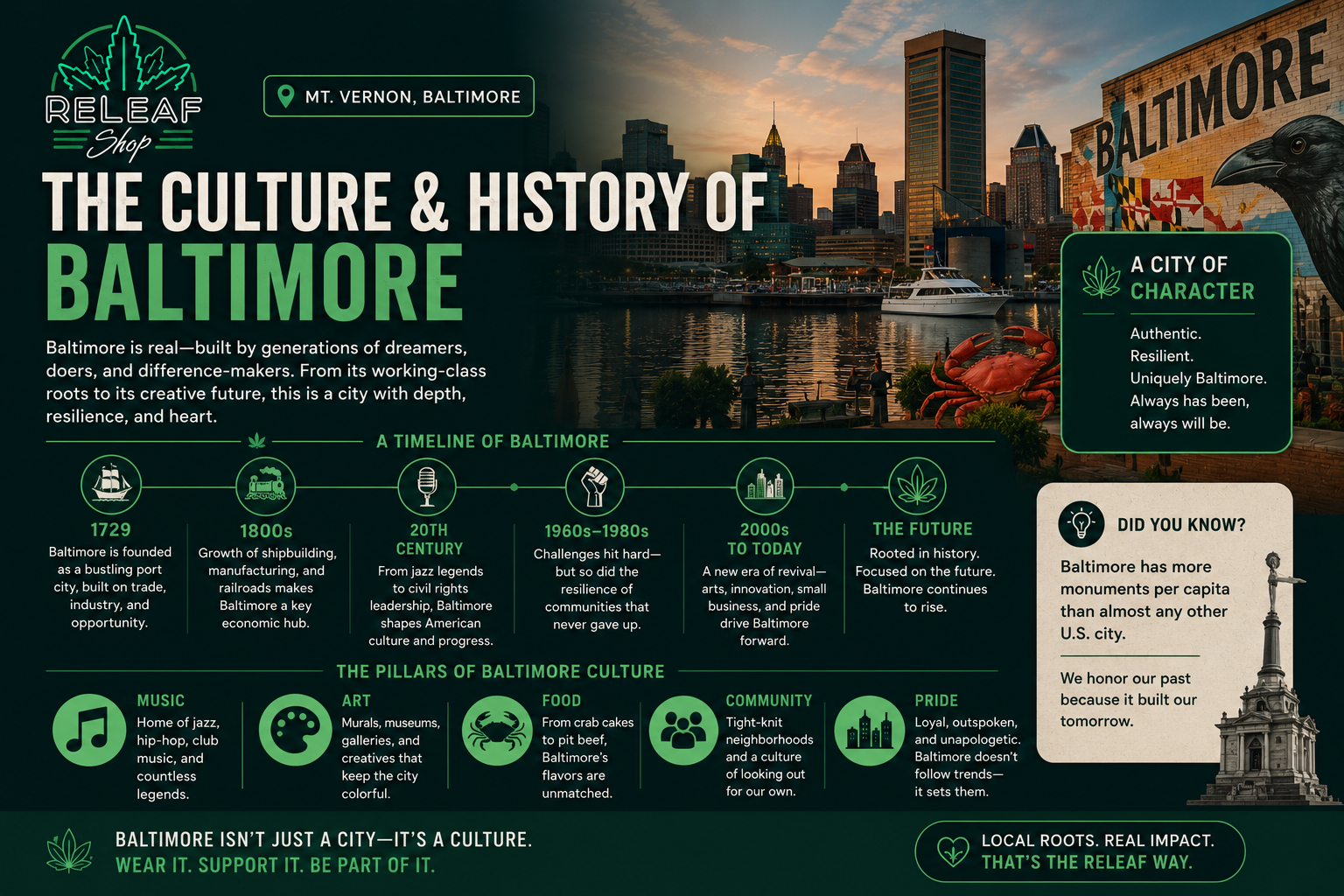
The regulated retail layer sits on top of decades of hip-hop, art, and advocacy that predates legalization. The broader picture.

Baltimore's cannabis culture predates the recreational launch by decades. The 2023 adult-use rollout changed retail; it didn't invent the underlying culture. What you see at ReLeaf and other Maryland dispensaries today is the regulated commercial layer on top of a much longer history — hip-hop, art, advocacy, music, and community organizing that ran through the city for generations before the law caught up.
This guide covers the broader cultural picture in Baltimore in 2026. It pairs with our existing pieces on hip-hop and cannabis culture and on cannabis celebrities, which cover specific slices in more depth. Worth reading them together for the fuller view.
Worth a section because the legal market doesn't make sense without the unregulated history that produced it.
Cannabis use in Baltimore has roots that go back at least to the early 20th century, when Black-led cultural scenes in cities like Baltimore, Harlem, and New Orleans built jazz clubs and cultural institutions where cannabis use was visible. The 1937 Marihuana Tax Act criminalized cannabis nationally; Maryland's enforcement followed federal patterns through most of the 20th century, with disproportionate impact on Black Baltimoreans.
The 1980s–2010s drug war hit Baltimore hard. Possession arrests, the carceral consequences, and the generational economic damage are documented in the city's enforcement records. Maryland's medical cannabis legalization in 2014 was the first formal break from that framework; the 2023 recreational launch was the second.
What makes Baltimore's cannabis culture distinctive in 2026 isn't the regulated retail — every state has that now. It's the layer underneath: the artists, advocates, hip-hop figures, community organizers, and longtime patients whose cultural work made the legal market possible.
Baltimore's hip-hop scene has been one of the most consistent cultural carriers of cannabis identity in the city. The throughline runs from the early Baltimore club scene through current artists making national-tier work.
Our deep-dive on hip-hop and cannabis culture in Baltimore covers this in detail. Worth reading the full piece if the music side is what brings you to the cannabis culture conversation.
The short version: cannabis has been part of Baltimore's musical identity in ways that overlap with but extend beyond the hip-hop scene. Jazz, soul, R&B, and contemporary genres all have artists and venues that have been cannabis-adjacent for decades. The legal market in 2026 connects to that musical history rather than creating something new.
The visual arts side of Baltimore's cannabis culture runs through several specific neighborhoods.
Mt. Vernon's gallery scene. Mt. Vernon's cultural district includes multiple small galleries that show contemporary Baltimore artists. The neighborhood is also home to ReLeaf Shop and the broader Cathedral Street commercial corridor. The overlap between gallery openings, cannabis-friendly evening events, and the dispensary's neighborhood foot traffic creates a soft ecosystem.
Station North Arts District. Designated as one of Baltimore's three official cultural districts, Station North hosts contemporary art events, music programming, and community gatherings. Cannabis culture is part of the broader scene without being the focus.
MICA student work. The Maryland Institute College of Art produces a steady stream of contemporary work, some of which engages cannabis themes directly. The student gallery openings, end-of-year shows, and graduate exhibitions are part of the wider cultural mix.
Cannabis-themed art in Baltimore's gallery scene tends to engage more critically than commercially. Work that grapples with the drug war, mass incarceration, social-equity questions, and the generational inheritance of cannabis prohibition shows up alongside celebratory or aesthetic work.
Maryland's social-equity program is one of the more active equity frameworks in the country, with specific implications for Baltimore.
The Maryland Cannabis Administration runs a social-equity license track that prioritizes operators with ties to communities disproportionately impacted by the drug war. A meaningful share of those operators are Baltimore-based. The program's progress and limitations are worth understanding for anyone engaged with cannabis culture in the city beyond just the consumer side.
Local advocacy organizations have been part of the pre-legalization conversation and continue working on post-legalization equity questions — expungement of past convictions, support for social-equity license holders, employment access for individuals with prior cannabis-related convictions. The advocacy layer is one of the things that makes Baltimore's cannabis scene different from purely commercial markets.
Worth knowing as a cannabis-curious Baltimorean: buying from social-equity-licensed operators is one practical way to align consumption with the broader equity conversation. ReLeaf Shop and other Maryland-licensed retailers carry products from a mix of operators across the equity spectrum.
Public consumption is prohibited in Maryland — the legal framework restricts cannabis use to private property. That shapes what kind of cannabis-related events can operate openly.
Annual events. 4/20 (April 20) is the largest cannabis-related cultural event nationally, with Baltimore-area events ranging from licensed retailer promotions to private gatherings. Green Wednesday (the day before Thanksgiving) is the secondary annual marker. Both drive measurable spikes in dispensary traffic and create opportunities for cultural programming around them.
Sesh events and private gatherings. Cannabis-themed parties, brand activations, and community gatherings happen in private venues throughout the year. These aren't publicly advertised in the same way that bars and restaurants are; the legal framework keeps the visibility lower.
Cannabis-themed yoga and wellness. A growing category in Baltimore. Studios that offer cannabis-adjacent programming — yoga sessions, breathwork classes, sound baths — typically structure the events as private gatherings on private property to comply with consumption rules.
Industry events. Maryland's cannabis industry hosts trade-focused events for retailers, cultivators, processors, and patients. These are professional rather than recreational but contribute to the cultural ecosystem.
Worth flagging that the consumption-on-premises restriction means Baltimore doesn't yet have cannabis cafes or social-consumption venues like Denver or Las Vegas. The legal framework would need to change for that to develop.
Baltimore has three officially designated arts and entertainment districts: Mt. Vernon, Station North, and Highlandtown. Each has a different relationship with cannabis culture.
Mt. Vernon Cultural District. Houses ReLeaf Shop, the Walters Art Museum, the Peabody Library, the Washington Monument, and a dense cluster of galleries, restaurants, and music venues. The cannabis culture in Mt. Vernon is integrated into the broader cultural mix — not foregrounded, but present in the neighborhood's daily rhythm.
Station North Arts District. The contemporary-arts-leaning district north of downtown. Music venues like Ottobar, gallery spaces, theater programming. Cannabis culture overlaps with the music and arts scenes; the area's evening foot traffic includes cannabis-adjacent events.
Highlandtown Arts and Entertainment District. East Baltimore's cultural anchor. Latino arts programming, contemporary galleries, music venues. Cannabis culture is present but less foregrounded than in Mt. Vernon or Station North.
The district designations don't grant special cannabis privileges — same consumption rules apply. But the cultural infrastructure makes these neighborhoods natural points of contact for cannabis-curious culture.
Honest framing about the cannabis-retail-and-culture relationship.
Dispensaries are commercial businesses operating under regulated retail licenses. Their primary function is selling licensed cannabis products to qualified consumers. They aren't community organizations, cultural institutions, or advocacy operations — even when they support those things peripherally.
The healthier relationship between dispensaries and cannabis culture is one where the dispensary supports cultural programming without claiming ownership of the culture. ReLeaf Shop's role in Mt. Vernon is more accurately described as one cultural-district business among many than as a cultural institution itself. Buying cannabis there is a transaction; the culture lives in the broader neighborhood and city.
For shoppers who want their cannabis spending to support broader cultural and equity work, options exist: prioritize social-equity-licensed brands, support local artists and venues that engage cannabis themes critically, contribute to advocacy organizations working on expungement and post-conviction support. The dispensary is one node in a wider network.
Worth a section because cannabis celebrities and influencers are part of the cultural conversation.
Our piece on cannabis celebrities and rising influencers covers the broader landscape. Berner (Cookies founder), Snoop Dogg, Wiz Khalifa, and similar figures have shaped cannabis brand identity at the national level; their influence on Baltimore-area cannabis culture is real but secondary to local figures.
The Baltimore-specific influence runs through local artists, hip-hop figures, advocates, and cultural organizers. Their work is less national-tier visible but more directly shaping the local culture day to day.
Several open questions about Baltimore's cannabis culture going forward.
Social-consumption venues. Maryland may eventually license cannabis cafes or consumption lounges. If and when that happens, Baltimore would likely see early operators in Mt. Vernon, Station North, or Federal Hill. The cultural texture of the city would change meaningfully — cannabis-friendly social spaces are different from take-home retail.
Equity progress. Maryland's social-equity program is still maturing. The next several years of license issuance, business support, and equity-focused regulation will shape who owns the legal cannabis market in Baltimore long-term.
Cultural programming. The legal market makes some cultural work easier (open programming, advertising, sponsorship) while restricting others (public consumption, certain advertising channels). The balance shapes what kind of cannabis culture is possible going forward.
Generational transition. The pre-legalization generation of Baltimore cannabis culture — the artists, advocates, and figures who shaped the underground era — is gradually overlapping with younger cohorts who only know the legal market. The cultural memory transfer matters for whether the post-legalization culture stays connected to its history.
Baltimore's cannabis culture in 2026 is a layered scene: the regulated retail layer (ReLeaf Shop, other dispensaries, licensed brands) sits on top of a longer history of hip-hop, art, advocacy, and community organizing that predates legalization by decades. The healthiest version of Baltimore cannabis culture is one where the commercial side supports the cultural side without claiming it. For cannabis-curious Baltimoreans, the broader cultural picture rewards engagement beyond the dispensary counter — the music, art, advocacy, and community organizing that produced the conditions for legalization remain the more interesting parts of the scene. See our evolution of medical marijuana in Maryland for the policy side of the story, and the hip-hop and cannabis piece for the music side.
For a taste of that culture in person, see our recap of the ReLeaf Shop x Jim Belushi in-store pop-up — the comedy legend's Baltimore visit.