
Order Online
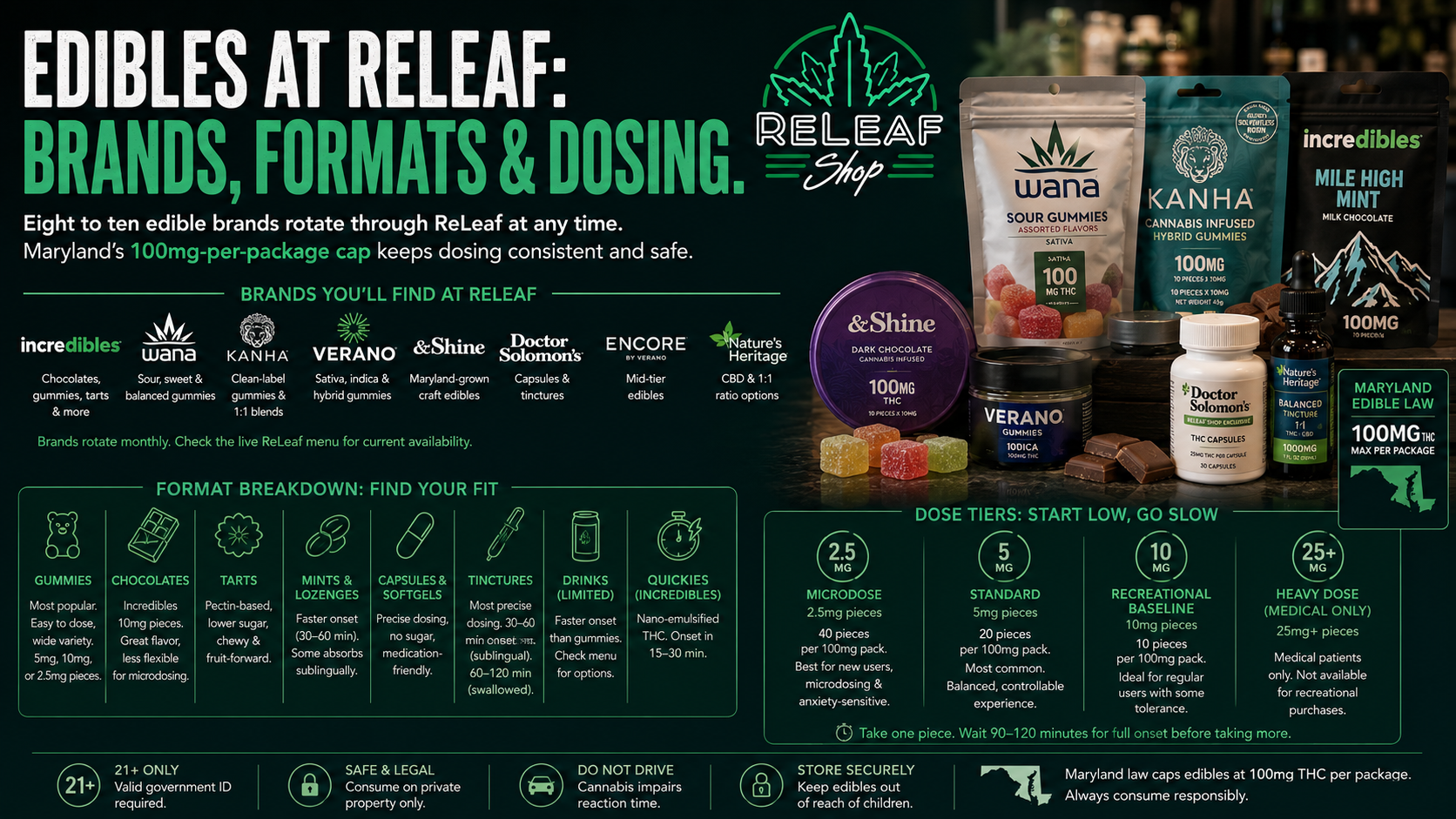
Eight to ten edible brands rotate through ReLeaf at any time. Format breakdown, dose tiers, and Maryland's 100mg-per-package cap.

Maryland's edibles case has expanded fast since the recreational launch in July 2023. ReLeaf typically carries eight to ten edible brands at any given time, with the rotation shifting monthly as new SKUs land and seasonal options come and go. This guide is a snapshot of what's currently on shelves — a refreshable inventory rather than an evergreen buyer's guide.
The named brands and formats below reflect the typical Maryland edibles mix. Specific availability rotates, so check the live ReLeaf menu before a planned trip.
The brands that turn over most consistently at ReLeaf.
Incredibles. Colorado-born chocolate brand with a deep Maryland presence. The 100mg, 10-piece chocolate bar is the format that put Incredibles on the map. Mile High Mint, Boulder Bar (milk chocolate), Strawberry, and seasonal limited runs all rotate through. Plus gummies, tarts, and the occasional Snoozeberry CBN-blend bar.
Wana. National gummies brand with sour, sweet, and balanced flavor lines. Sativa, indica, and hybrid blends across the format. Reliably stocked.
Kanha. West-coast gummy brand with a cleaner texture profile than most competitors. Lower-sugar formulations, multiple ratio options including 1:1 CBD-THC blends.
Verano gummies. Verano's edibles line. Sativa, indica, and hybrid options at standard 100mg packs.
&Shine. Maryland-grown brand with edibles that pull from craft flower extracts. Smaller-format runs, slightly higher pricing, distinctive packaging.
Doctor Solomon's. Capsule and tincture-leaning brand. Useful for medical patients and users who want precise dosing without sugar or chocolate.
Encore (Verano). Verano's mid-tier edibles. Less common than the Verano gummies but rotates through periodically.
Nature's Heritage. Maryland-focused edibles with several ratio options including CBD-dominant.
For specific current stock and pricing, the live ReLeaf menu is the source of truth. The brand mix shifts as new releases come through.
What each edible format is good for.
Gummies. The dominant format. Pre-dosed in 5mg, 10mg, or occasionally 2.5mg pieces. Easy to dose-titrate, predictable onset, wide flavor selection. Most brands lead with gummies. The 100mg-per-package cap means you typically get a 10-piece pack or 20-piece half-dose pack.
Chocolates. The Incredibles category. Pre-scored bars with 10mg pieces. Better for users who prefer chocolate to fruit flavors; worse for users who want to titrate doses below 10mg without halving pieces with a knife.
Tarts. Pectin-based, lower-sugar alternative to gummies. Chewier texture, less artificial-flavor profile. Often paired alongside gummies on shelves.
Mints and lozenges. Faster-onset format than standard edibles. Some absorption happens sublingually before swallowing, shortening the onset window to 30–60 minutes versus the 60–120 minutes for standard chewable edibles.
Capsules and softgels. Precise dosing, no flavor, designed for users who treat cannabis like medication. Common among patients managing chronic conditions.
Tinctures. Liquid extract dosed by dropper. Sublingual administration onsets in 30–60 minutes; swallowed administration onsets like a standard edible. Most precise dose control of any format.
Drinks (limited stock). Cannabis-infused beverages have grown as a category. Faster onset than chewable edibles for most products. ReLeaf carries some drink options when available, but the category is less consistently stocked than gummies and chocolates.
Quickies (Incredibles fast-onset gummies). A specific Incredibles product line that uses nano-emulsified THC for faster onset — typically 15–30 minutes versus the 60–120 minutes for standard edibles. Worth knowing for users who want edible duration with shorter onset.
Maryland's per-package edible cap is 100mg of THC. Within that constraint, brands offer different per-piece doses.
Microdose (2.5mg pieces). The lowest-dose option. 40-piece packs at 100mg total. Good for new users, anxiety-sensitive consumers, and microdose-protocol patients.
Standard (5mg pieces). 20-piece packs at 100mg total. The most common format. Suitable for users who want clear effect without high intensity.
Recreational baseline (10mg pieces). 10-piece packs at 100mg total. The format most regular cannabis users settle into. Strong but not overwhelming for users with edible tolerance.
Heavy (25mg+ pieces — medical only). Higher-dose edibles are restricted to Maryland medical patients. Recreational customers can't access these. Useful for patients with established tolerance and specific dosing requirements.
For first-time edible users, the 2.5mg or 5mg piece is the right starting point. Take one piece, wait the full 90–120 minutes for onset, then decide whether to take more. Don't redose before 90 minutes — the most common bad-edible-experience pattern starts with "I don't feel anything yet, I'll take another."
Most edible brands offer sativa, indica, and hybrid versions. Worth understanding what those labels actually mean for edibles.
Sativa edibles. Marketed as energetic, daytime-suitable, head-clear. The reality: edible cannabinoid extract is mostly distillate (THC), with terpenes added back in to mimic the source strain. The "sativa" label is directional rather than strict botanical.
Indica edibles. Marketed as relaxing, evening-suitable, body-heavy. Same caveat. The terpene blend points the experience in the indica direction, but the dominant variable is still THC dose.
Hybrid edibles. Balanced terpene profile. Often the brand's everyday baseline.
CBD-blend edibles. 1:1 THC-to-CBD or higher CBD ratios. Different effect curve. Less anxiety risk, less intoxication, useful for users who want cannabinoid benefits without the THC-driven high. Wana, Kanha, and Doctor Solomon's all carry CBD-blend options.
CBN-blend edibles (sleep-leaning). Some brands offer CBN-enhanced edibles marketed for sleep. The Snoozeberry indica bar from Incredibles is the most-recognized example. Research on CBN's sedating effects is preliminary; many users report subjective improvement.
The 100mg-per-package cap is the central rule shaping Maryland's edibles market. Worth understanding.
Maryland's adult-use cannabis regulations limit edibles to 100mg of THC per package. This applies to recreational sales; medical patients can purchase higher-mg packages. The cap shapes what brands can produce — you'll see a lot of 10-piece, 10mg-each packs, and 20-piece, 5mg-each packs, but not 200mg single bars.
Per-transaction limits also apply. Recreational customers can purchase up to 750mg of THC in edible form per single transaction — about seven 100mg packages. Medical patients have higher allotments.
The 100mg cap is sometimes restrictive for experienced users. A patient managing chronic pain might prefer a 500mg single-package option for dosing simplicity. The recreational cap forces multiple packages, which adds packaging waste and slight cost premium. Worth knowing if you're shopping recreationally with high tolerance.
The most-skipped piece of edible advice in the industry: edibles take time to fully come on, and the dose-response curve is unforgiving.
Start at 2.5mg if you're new. Half a 5mg piece, or one 2.5mg piece. Wait the full 90–120 minutes for onset. Don't redose during the wait period.
Start at 5mg if you have flower or vape tolerance but no edible experience. Edibles hit differently than smoked cannabis. Tolerance built from inhaled use partially transfers but not fully.
Standard recreational dose: 10mg. Most regular users settle here. Suitable for evening relaxation or weekend recreational use.
Tolerant users: 15–25mg. Heavy daily users can comfortably handle higher doses. The risk shifts from "too high" to "tolerance creep" — the doses keep climbing.
What to do if you take too much. Bad edible experiences pass within 4–6 hours. Stay calm, drink water, eat food, sit somewhere comfortable. CBD can blunt the THC effect somewhat. Black pepper (containing beta-caryophyllene) is sometimes recommended though the research is preliminary. Most importantly: it will pass.
Our guide to how THC interacts with the body covers the absorption science.
When edibles are the right choice and when something else makes more sense.
Edibles win when: You want long-acting effect (6–8 hours). You want discreet consumption with no smell. You want predictable, pre-dosed pieces. You're using cannabis for sleep duration coverage. You want to avoid smoking or vaping for health reasons.
Edibles lose when: You want fast onset (under 30 minutes). You want short duration (under 3 hours). You want to titrate dose by feel rather than committing to a long timeline. You're new to cannabis and want fast feedback on whether the dose is right.
Better alternatives for fast onset. Vape pens, smoked flower, or sublingual tinctures. All onset in 5–30 minutes versus 60–120 for chewable edibles.
Better alternatives for precision. Tinctures and sublingual sprays. Drop-by-drop dosing finer than 1mg increments.
ReLeaf typically carries eight to ten edible brands at a time, with stock rotating as new SKUs arrive and seasonal products come and go. Common brands in the rotation include Incredibles, Wana, Kanha, Verano, &Shine, Doctor Solomon’s, Encore, and Nature’s Heritage.
For recreational cannabis, Maryland caps edibles at 100mg of THC per package. That rule shapes the market, which is why most edible packs are sold as 10 pieces at 10mg each, 20 pieces at 5mg each, or 40 pieces at 2.5mg each.
For recreational customers, yes — edible packages are limited to 100mg THC per package. Medical patients can access higher-mg edible products, including stronger per-piece dose options.
For first-time edible users, 2.5mg or 5mg is the recommended starting point. New users should take one dose and wait the full 90–120 minutes before deciding whether to take more.
Most standard chewable edibles take 60–120 minutes to fully kick in. Tinctures and sublingual products can start in 30–60 minutes, while fast-onset edibles like nano-emulsified products may kick in within 15–30 minutes.
Gummies are the dominant edible format because they are easy to dose, widely available, and come in multiple dose tiers. ReLeaf also commonly carries chocolates, tarts, mints, lozenges, capsules, softgels, tinctures, and occasionally cannabis drinks.
Gummies are usually easier to dose-titrate because they often come in 2.5mg, 5mg, or 10mg pieces. Chocolate bars, like many Incredibles products, are commonly pre-scored into 10mg pieces and work well for shoppers who prefer chocolate over fruit-flavored edibles.
Sleep-leaning edible options often include CBN-blended products and indica-labeled edibles. The blog specifically highlights products like Incredibles Snoozeberry as a recognizable sleep-oriented option, while brands like Wana, Kanha, and Verano also offer indica-style edibles many users choose for evening use.
Sativa edibles are generally marketed as more energizing, indica edibles as more relaxing, and hybrids as more balanced. In practice, the effect is still heavily influenced by THC dose, with terpene blends helping shape the experience directionally.
Yes. ReLeaf’s edible mix often includes CBD-blend options, such as 1:1 THC-to-CBD products and other higher-CBD formats. These can appeal to users who want a lighter, less intoxicating effect than THC-only edibles.
For recreational shoppers, the strongest legal format is generally still constrained by the 100mg-per-package cap. Most recreational products top out at 10mg per piece, while medical-only edible products can go higher, including 25mg+ per piece options.
Maryland recreational rules allow customers to purchase up to 750mg of THC in edible form per transaction, which works out to about seven 100mg packages.
Edibles are often better for people who want longer-lasting effects, discreet consumption, no smoke smell, and no inhalation. Smoking or vaping may be a better fit when the user wants faster onset, shorter duration, or easier real-time dose adjustment.
If you take too much, the most important thing to know is that the experience will pass, usually within 4–6 hours. The blog recommends staying calm, drinking water, eating food, and sitting somewhere comfortable while waiting it out.
Maryland's edibles case at ReLeaf rotates through eight to ten brands at any given time, with format coverage from chocolates and gummies to tarts, mints, capsules, and tinctures. The 100mg-per-package cap shapes what's available; the per-piece dose shapes how you should approach a first purchase. Start small, wait the full onset window, scale up only after you know how your body responds. For specific brands and pricing, the live ReLeaf menu is the source of truth — this snapshot reflects the typical Maryland edibles mix but specific stock changes monthly.
.jpeg)

.jpeg)