
Order Online
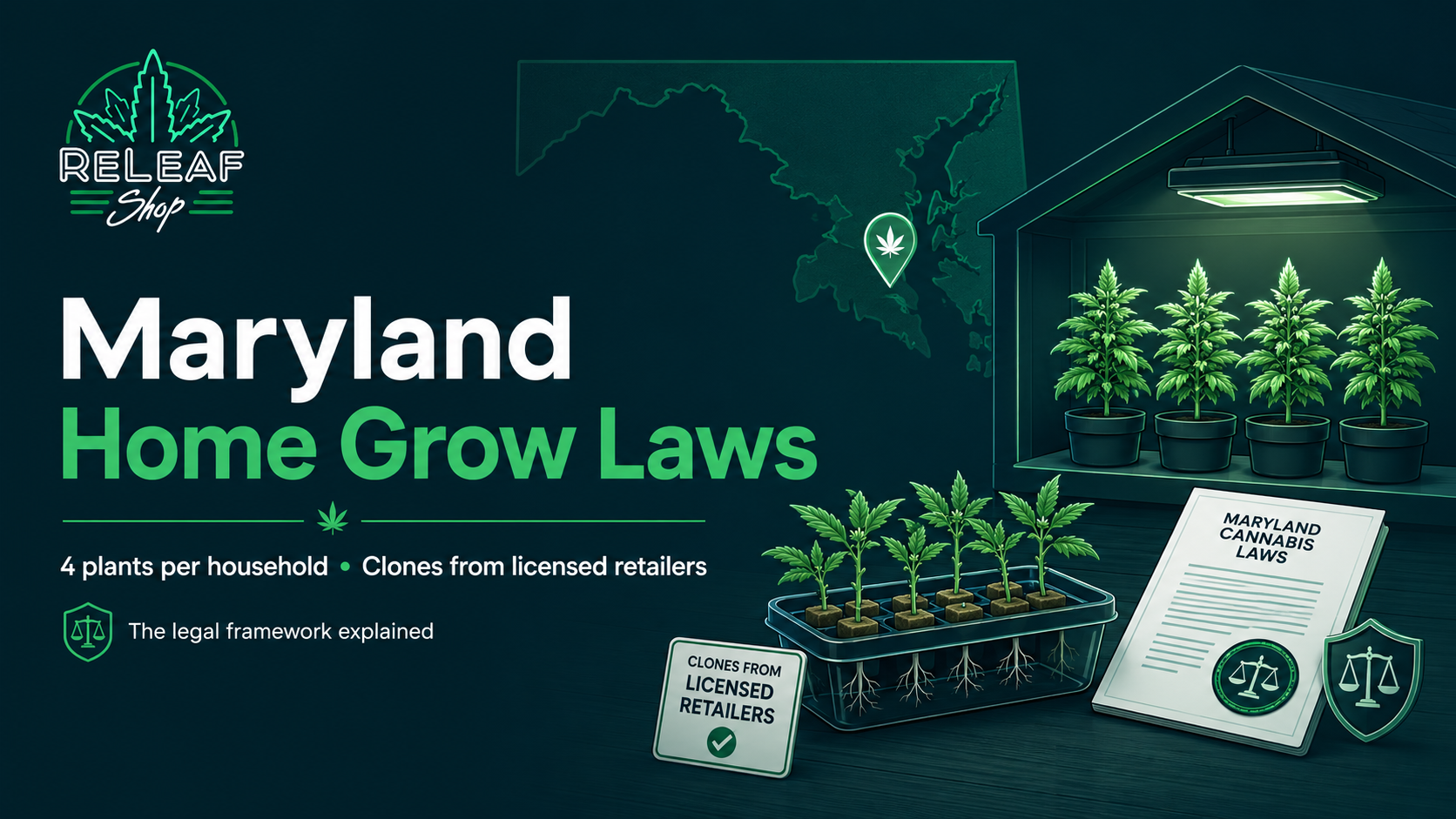
Maryland allows up to 4 plants per household. Clones come from licensed retailers, not dispensaries. The legal framework explained.

Maryland's adult-use cannabis program allows limited home cultivation — a small number of plants per household, on the resident's own property, in a private space not visible from public view. Cannabis clones (rooted cuttings from existing cannabis plants) are the typical starting point for home growers who want predictable strain genetics. ReLeaf Shop, like most Maryland dispensaries, doesn't sell clones — that's a different licensing category. This guide covers what's legal, where Maryland residents can legally source clones, and why the dispensary isn't part of that picture.
Worth flagging upfront: Maryland's home-grow rules are detailed and have evolved since the 2023 recreational launch. The information below reflects the current framework as of 2026, but home growers should verify specifics with the Maryland Cannabis Administration before investing in equipment or sourcing plants.
The legal framework for personal cannabis cultivation in Maryland.
Plant count. Maryland allows up to four cannabis plants per household at any given time — not per adult, per household. A two-adult household still maxes out at four plants total. Of those four, no more than two can be flowering simultaneously; the others must be in vegetative state or younger.
Who can grow. Any adult 21 or older can grow up to the household limit. The plants must belong to a resident of the property, not a non-resident permitted to grow there.
Where you can grow. The cultivation must take place on property the grower owns or rents (with landlord permission for renters). The plants must be in a space not visible from public spaces — inside the residence, in a fenced backyard, in an enclosed greenhouse, or similar.
Distance from schools. Maryland's medical cannabis program restricts dispensaries within 1,000 feet of K–12 schools. Home cultivation rules are less strict but still apply some distance restrictions for some jurisdictions.
Sale prohibited. Home-grown cannabis cannot be sold, even to other adults. Personal use only.
The current Maryland Cannabis Administration page on home cultivation has the most up-to-date specifics. Don't rely on summary guides for legal-compliance decisions.
This is where the dispensary picture matters. Maryland's licensing structure separates cultivation from retail.
Licensed cultivators. The cultivators that produce flower for Maryland dispensaries are licensed for commercial cultivation, not retail clone sales. They aren't the source for home-grow clones.
Licensed clone retailers. Maryland has a separate licensing category for clone retail. Some Maryland-licensed nurseries or specialty retailers sell clones to qualified home growers under specific regulations. This is the legal path for sourcing clones.
Patient-to-patient transfers (medical only). Some states allow medical patients to share clones with other registered patients under specific conditions. Maryland's framework on this evolves; check current rules.
Seeds. Cannabis seeds are easier to source legally than clones. Several Maryland dispensaries sell seeds, and online seed retailers ship to Maryland residents under federal-protected seed-sales rules. Seeds are the more common starting point for new home growers.
The gray-market reality: many Maryland home growers source clones from informal networks rather than licensed retailers. This carries legal risk — the underlying cannabis remains regulated, and unauthorized clone sales are a violation. The legal path is licensed retailers and cultivator partners.
The licensing structure splits cannabis sales into specific categories.
Dispensary licenses are for finished product. ReLeaf Shop's license covers the sale of finished cannabis products to consumers — flower, edibles, vapes, concentrates, topicals. Live plant material falls under a different licensing category.
Cultivator licenses are for production, not direct retail. The cultivators that grow the flower sold at dispensaries don't have direct-to-consumer retail privileges. Their relationship with consumers runs through licensed dispensaries.
Clone retail requires its own license. Some Maryland operators have clone-retail licenses, but the licensing footprint is smaller than dispensary licenses. There are fewer clone retailers than dispensaries.
What dispensaries can sell. Cannabis seeds, finished cannabis products, accessories. Clones aren't on the approved retail list for standard dispensary licenses.
For Maryland residents who want to home-grow, the dispensary is the place to buy seeds (when in stock) and finished cannabis for personal consumption. Clones come from elsewhere.
The most-asked decision for new Maryland home growers.
Clones. Genetic copies of an existing cannabis plant. Predictable phenotype — the strain you start with is the strain you finish with. Faster path to harvest because the plant is already established. Higher risk of pest and disease transfer if the source plant is unhealthy. More expensive per plant, $20–50 typical for a quality clone.
Seeds. Genetic mix from two parent plants. Phenotype variation across seeds — ten seeds of the same strain produce ten plants with subtle (or significant) differences. Slower path to harvest because plants start from germination. Lower disease risk. Cheaper per plant, $10–15 per quality seed.
Feminized vs. regular seeds. Cannabis plants are dioecious — male and female plants exist. Only female plants produce the flower that home growers want; male plants are for breeders. Feminized seeds (~99% female) save the headache of identifying and removing males. Regular seeds (~50/50) require more effort but are sometimes cheaper.
Auto-flowering seeds. A specific genetic line that flowers based on age rather than light cycle. Easier for indoor growers without sophisticated lighting; harvest in 8–12 weeks from germination.
For new home growers, feminized seeds are typically the right starting point. Cheaper than clones, lower disease risk, manageable phenotype variation. Clones make more sense once a grower has identified a specific strain phenotype they want to replicate.
Worth flagging because plant cultivation is a substantial commitment.
Time to harvest. 8–12 weeks for indoor auto-flowering plants; 12–20 weeks for indoor photoperiod plants; 16–24 weeks for outdoor seasonal grows. Home-grown cannabis is a slow harvest cycle, not a same-day pickup.
Equipment cost. A basic indoor grow setup runs $300–800 for grow tent, lighting, ventilation, and starter supplies. Higher-end setups can exceed $2,000. Outdoor grows have lower equipment costs but climate constraints.
Yield expectations. A four-plant home grow can produce 4–12 ounces of finished flower per harvest cycle, depending on strain, environment, and grower skill. Not enough to replace dispensary buying for heavy users; supplement-level production for casual users.
Quality variability. Home-grown quality varies widely. Some growers produce flower comparable to dispensary mid-tier; others produce barely-usable harvests that disappointed expectations. Skill builds over multiple cycles.
Time investment. Daily watering, light monitoring, pest checks, post-harvest curing. Home growing is a real hobby commitment, not passive supply replacement.
For most Maryland residents, the math doesn't work — dispensary buying is more efficient per dollar and per hour. Home-growing makes sense for users who enjoy the cultivation process itself, not just the cannabis it produces.
Even though clones aren't on the menu, ReLeaf is still part of the home-grower picture in a few ways.
Seeds. Some Maryland dispensaries stock cannabis seeds when supply allows. Worth checking the menu for current seed availability if you're starting a home-grow project.
Finished cannabis while you wait. Home grows take months. Most home growers continue buying dispensary product during the cultivation cycle, especially during the early grows where harvest results are uncertain.
Strain reference. Trying dispensary product helps identify which strains you want to home-grow. The flower selection at ReLeaf includes Maryland-grown strains across the genetic spectrum, which gives you a working library for picking your home-grow targets.
Budtender consultation. Some Maryland budtenders have personal home-grow experience and can offer practical advice on strain selection, basic equipment, and learning resources. Worth asking if you're new to cultivation.
Yes. Maryland allows limited home cultivation for adults 21 and older, but the plants must be grown on private property, kept out of public view, and remain within the state’s household plant limits.
Maryland allows up to four cannabis plants per household, not per adult. No more than two plants can be flowering at the same time.
The limit is per household. A household with two or more adults still maxes out at four total cannabis plants.
Yes, but only on private property you own or rent, and the plants must not be visible from public spaces. Renters need landlord permission before growing cannabis at the property.
No. ReLeaf Shop does not sell cannabis clones because standard dispensary licenses cover finished cannabis products, not live plant material. Clones come from licensed clone retailers, not regular dispensaries.
Cannabis clones must be purchased from licensed clone retailers or specialty operators authorized to sell live plant material. Buyers should verify the source is licensed before purchasing.
Maryland separates finished cannabis retail from live plant material. Dispensaries can sell finished products like flower, edibles, vapes, concentrates, topicals, and sometimes seeds, but clones require a separate licensing category.
Sometimes. Some Maryland dispensaries may carry cannabis seeds when supply allows, but availability changes. ReLeaf customers should check the live menu for current seed stock.
Clones give more predictable genetics and a faster path to harvest because they are rooted cuttings from an existing plant. Seeds are usually cheaper, lower-risk for pests or disease, and better for many new growers.
Feminized seeds are bred to produce female cannabis plants, which are the plants that produce usable flower. They are usually easier for beginners than regular seeds because growers do not need to identify and remove male plants.
Auto-flowering seeds produce plants that flower based on age rather than light cycle. They are often easier for beginner indoor growers and can finish faster than traditional photoperiod plants.
Home-grow timelines vary by seed type and setup. Indoor auto-flowering plants may finish in 8–12 weeks, indoor photoperiod plants often take 12–20 weeks, and outdoor seasonal grows can take 16–24 weeks.
A basic indoor setup can cost around $300–800 for a grow tent, lighting, ventilation, and starter supplies. Higher-end setups can cost more than $2,000.
No. Selling home-grown cannabis is prohibited in Maryland. Home cultivation is for personal use only, and any sale or barter violates the home-grow framework.
Not always. Home growing requires equipment, time, daily maintenance, drying, curing, and multiple grow cycles to build skill. For many Maryland residents, dispensary buying is more efficient unless they enjoy cultivation as a hobby.
Maryland's home-grow framework allows up to four plants per household for adult residents, with cultivation restricted to private property and personal use. Dispensaries don't sell clones — that's a separate licensing category, and Maryland residents who want clones need to source from licensed clone retailers. ReLeaf Shop's role in the home-grow picture is finished cannabis product, occasional seed availability, and strain-selection reference. For Maryland residents considering home cultivation, the legal framework is generous compared to many states, but the practical investment of time and equipment makes it a real hobby commitment rather than a casual supply replacement. See our Maryland cannabis laws guide for the broader regulatory framework.
.jpeg)
.jpeg)