Order Online
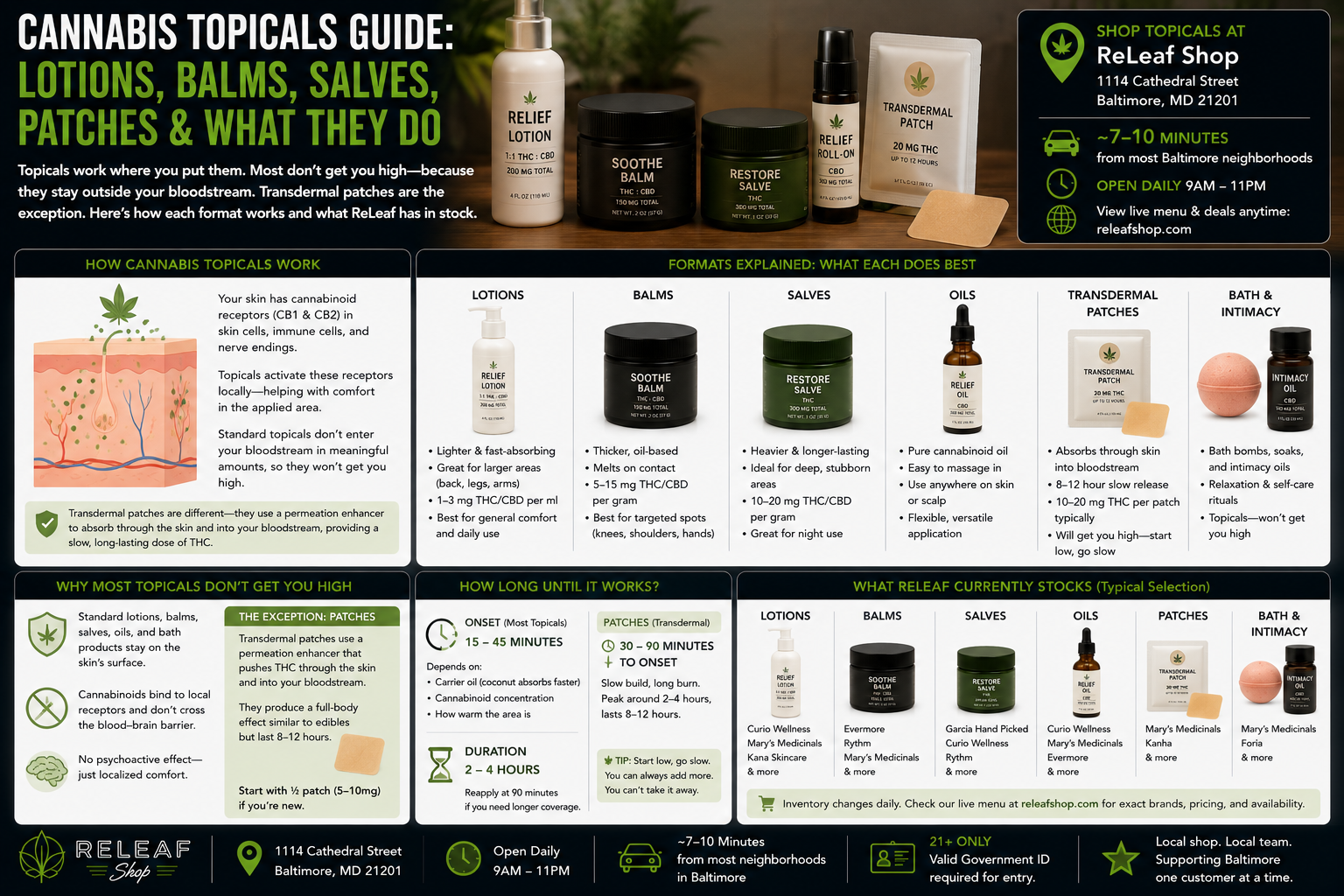
Lotions, balms, salves, transdermal patches — what each format does, why most don't get you high, and what ReLeaf currently stocks.

Cannabis topicals are the most-misunderstood category in the dispensary case. The misunderstanding is consistent and predictable: shoppers assume topicals will get them high, the way smoked or eaten cannabis does. They won't — with one exception worth knowing about. That exception is the transdermal patch, which is a different product than a standard topical even though they both go on skin.
The category is small but interesting. ReLeaf carries cannabis lotions, balms, salves, oils, bath products, and at least one or two transdermal options at any given time. Patients use them for localized comfort. Recreational customers tend to discover them later, after the standard formats stop being novel.
The skin has cannabinoid receptors. CB1 and CB2 receptors sit in skin cells, immune cells, and nerve endings throughout the body — part of the broader endocannabinoid system that regulates inflammation, pain signaling, and tissue repair. The body produces its own cannabinoids (endocannabinoids) that bind to these receptors continuously; topical cannabis adds external cannabinoids to the local mix.
Topical cannabis products engage those receptors locally — the cannabinoids bind in the area where the lotion is applied and don't enter the bloodstream in meaningful concentrations. That's why a standard topical doesn't get you high. The cannabinoids never reach the brain. They're acting on skin and tissue receptors at the application site only.
This local action is what makes topicals interesting for users seeking comfort in a specific spot — a sore knee, a stiff shoulder, a tense neck. The cannabinoids work where you put them, and they don't trigger the systemic effect that flower or edibles produce.
Transdermal patches break the rule. They're built differently than lotions and salves.
A transdermal patch contains a permeation enhancer that pushes cannabinoids through the skin barrier and into the bloodstream over 8–12 hours. The result is a sustained, slow-release dose of THC — sometimes 20mg or more — that absolutely will get you high.
Maryland-licensed transdermal patches typically sit in the 10–20mg THC range. They're stronger than they look. A first-time user should treat a transdermal patch with the same caution as a 10mg edible. Possibly more — the slow-release profile means peak effect arrives unpredictably and lingers.
If you want localized comfort without intoxication, you want a lotion or balm. If you want a long-acting systemic dose without smoking or eating, you want a transdermal patch. Two different products solving two different problems.
The topical case at most Maryland dispensaries breaks down into a few standard formats.
Lotions. Lighter, faster-absorbing, suitable for larger areas. Cannabinoid concentration typically 1–3 mg per ml. Best for general-area application.
Balms and salves. Thicker, oil-based, slower-absorbing. Higher cannabinoid concentration per scoop, usually 5–15 mg per gram. Best for targeted spots — knees, shoulders, hands.
Oils. Pure carrier oil with cannabinoids, no thickener. Used for massage, scalp application, or anywhere you want easy spread.
Patches (transdermal). The systemic exception described above. Adheres to skin for 8–12 hours.
Bath products. Bath bombs and soaks containing cannabinoids. The skin contact is brief and the cannabinoid concentration relative to bath volume is low — these are more about ritual than active dose.
Intimacy products. Cannabinoid-infused oils designed for intimate use. A separate category with its own labeling and use guidance.
Roll-ons and sticks. Stick-format applicators (like deodorant tubes) that pre-dose a thin layer of balm. Convenient for travel.
Most users feel local effects from a balm or salve in 15–45 minutes. Onset depends on three things: the carrier oil's penetration profile, the cannabinoid concentration, and how warm the application area is.
Coconut-oil-based balms penetrate faster than beeswax-heavier salves. A 6mg-per-gram balm hits faster than a 1mg-per-gram lotion. And warm tissue (post-workout, post-shower) absorbs more readily than cool tissue. None of these are dramatic differences, but they add up.
Effects typically last 2–4 hours from a standard application. If you need longer coverage, reapply at the 90-minute mark or step up to a transdermal patch — the patch's 8–12 hour profile covers the gap a topical can't.
The cannabinoid mix in a topical changes what it does. Three common ratios on the menu.
THC-dominant topicals. The cannabinoid-receptor activation is mostly via CB1, which sits in skin, immune cells, and pain pathways. THC topicals tend to read more pronounced for users with localized soreness or inflammation. They don't get you high (standard topicals don't), but the local effect is generally stronger than CBD-only.
CBD-dominant topicals. CBD acts on multiple receptor systems — CB2, vanilloid receptors, serotonin pathways. Some users find CBD topicals work better for nervous-system-driven complaints (tension headaches, jaw tension) than THC versions. The effect is subtler.
1:1 balanced topicals. The middle path. Tends to be the most flexible pick if you're not sure which cannabinoid your body responds to. ReLeaf carries balanced topicals from multiple Maryland producers.
If a drug test matters, CBD-only topicals are the safer pick — but read the label for THC content, since "CBD" products can legally contain trace THC under some certifications.
The topical case at ReLeaf rotates more slowly than the flower or vape side. A typical week shows three or four lotions, two or three balms or salves, a transdermal-patch option or two, and occasional bath or intimacy products.
Brand mix typically includes Maryland-licensed manufacturers and a handful of national brands that distribute through MD partners. The live ReLeaf menu shows current topicals stock — it's the fastest way to see what's available before a trip.
Pricing is generally in the $20–60 range depending on size and cannabinoid load. A 1.5oz balm at 200mg total cannabinoids is typical mid-tier; transdermal patches sit closer to $15–25 each.
People reach for topicals for specific reasons. Worth naming the common ones, with the standard caveats — these are user-reported uses, not medical recommendations.
Joint and muscle soreness after activity. Post-run knee, post-workout shoulders, post-shovel-the-driveway lower back. The most common reach. Users typically apply a balm directly on the area and wait 30–60 minutes for the local effect to settle in.
Neck and shoulder tension. Standard tension-spot application.
Skin conditions. Some users apply topicals to dry patches, eczema flares, or other skin irritation. The research here is less developed than the soreness use case — anecdotal but common enough to mention.
Period cramps. Topicals applied to the lower abdomen or lower back are a frequent use among users seeking localized comfort.
Headaches. Less common but reported. Temple application of a thin balm or oil.
None of the above is a medical claim. Cannabis topicals may help users manage specific kinds of localized comfort. They don't treat or cure any underlying condition. If you have a medical issue you're trying to address, a clinician's input is the right first step. Our beginner's medical guide covers when cannabis fits into a broader treatment approach.
Cannabinoid concentration is what matters for topicals — the milligrams per gram or per milliliter, not the total milligrams in the package. Two products with the same total mg can deliver very different doses per application.
A 100mg balm in a 30g jar contains roughly 3mg per gram. A 200mg balm in a 30g jar contains roughly 6mg per gram. Same form factor, twice the concentration. The smaller-mg-per-gram product is fine for general use; the higher-concentration product is what you want for targeted spots that need more.
Read the label. The total package mg is on the front. The per-gram or per-ml concentration is usually on the back or in fine print. Ignore the front-of-package number on its own.
Most cannabis topicals do not get you high. Lotions, balms, salves, oils, and bath products work locally on skin receptors and do not enter the bloodstream in meaningful amounts. Transdermal patches are the exception because they are designed to push cannabinoids into the bloodstream.
The key difference is the bloodstream. Standard topicals stay local and are used for targeted comfort. Transdermal patches use permeation enhancers to move cannabinoids through the skin and into the bloodstream, producing longer-lasting systemic effects and potential intoxication.
ReLeaf typically carries a rotating selection of lotions, balms, salves, oils, bath products, intimacy products, roll-ons, sticks, and transdermal patches. The exact topical stock changes more slowly than flower or vape inventory, but the live menu is the best source for current availability.
Cannabis lotions are lighter and faster-absorbing than balms or salves. They are usually better for larger application areas like arms, legs, back, or general daily use.
Balms and salves are thicker, oil-based products that work well for targeted areas like knees, shoulders, hands, neck, or lower back. They usually absorb more slowly and may carry a higher cannabinoid concentration per scoop than lotions.
Most standard topicals take about 15–45 minutes to produce local effects. Onset depends on the carrier oil, cannabinoid concentration, and whether the application area is warm, such as after a workout or shower.
A standard lotion, balm, salve, or oil usually lasts about 2–4 hours after application. Transdermal patches last much longer, often around 8–12 hours, because they deliver cannabinoids into the bloodstream over time.
THC-dominant topicals may feel more pronounced for localized soreness or inflammation, while CBD-dominant topicals may feel subtler and may appeal to users focused on tension or nervous-system-related discomfort. Balanced 1:1 THC/CBD topicals are often a flexible starting point.
Many users apply cannabis topicals for localized comfort in areas like sore knees, shoulders, backs, hands, or necks. These are user-reported use cases, not medical claims, and anyone managing a medical condition should talk with a clinician.
Some users apply topicals to the lower abdomen or lower back for period cramps, or use a thin balm near the temples for headaches. These uses are common anecdotally, but cannabis topicals do not treat or cure underlying medical conditions.
Standard topicals usually do not, because they do not enter the bloodstream in meaningful amounts. Transdermal patches are different and may show up because they deliver THC systemically. If drug testing matters, avoid THC transdermals and read labels carefully.
Yes. Cannabis topicals are legal in Maryland when produced and sold through licensed Maryland dispensaries. ReLeaf carries Maryland-licensed topical products as part of its rotating menu.
Look at the milligrams per gram or milligrams per milliliter, not just the total package THC or CBD number. A 200mg balm in a 30g jar is twice as concentrated as a 100mg balm in the same jar, even if both packages look similar.
Transdermal patches require caution for beginners because they can deliver 10–20mg THC slowly over several hours and may produce intoxication. A first-time user should treat a THC patch more like an edible than a regular topical.
Cannabis topicals are the right tool for specific jobs. Localized comfort, targeted application, no high. The transdermal patch is the systemic exception — useful for long-acting dosing, not what most people are looking for when they reach for a "topical." Read the label for cannabinoid concentration per gram or per milliliter, choose the format that fits your application area, and start with a thin layer. The live ReLeaf menu shows current topicals stock.