Order Online
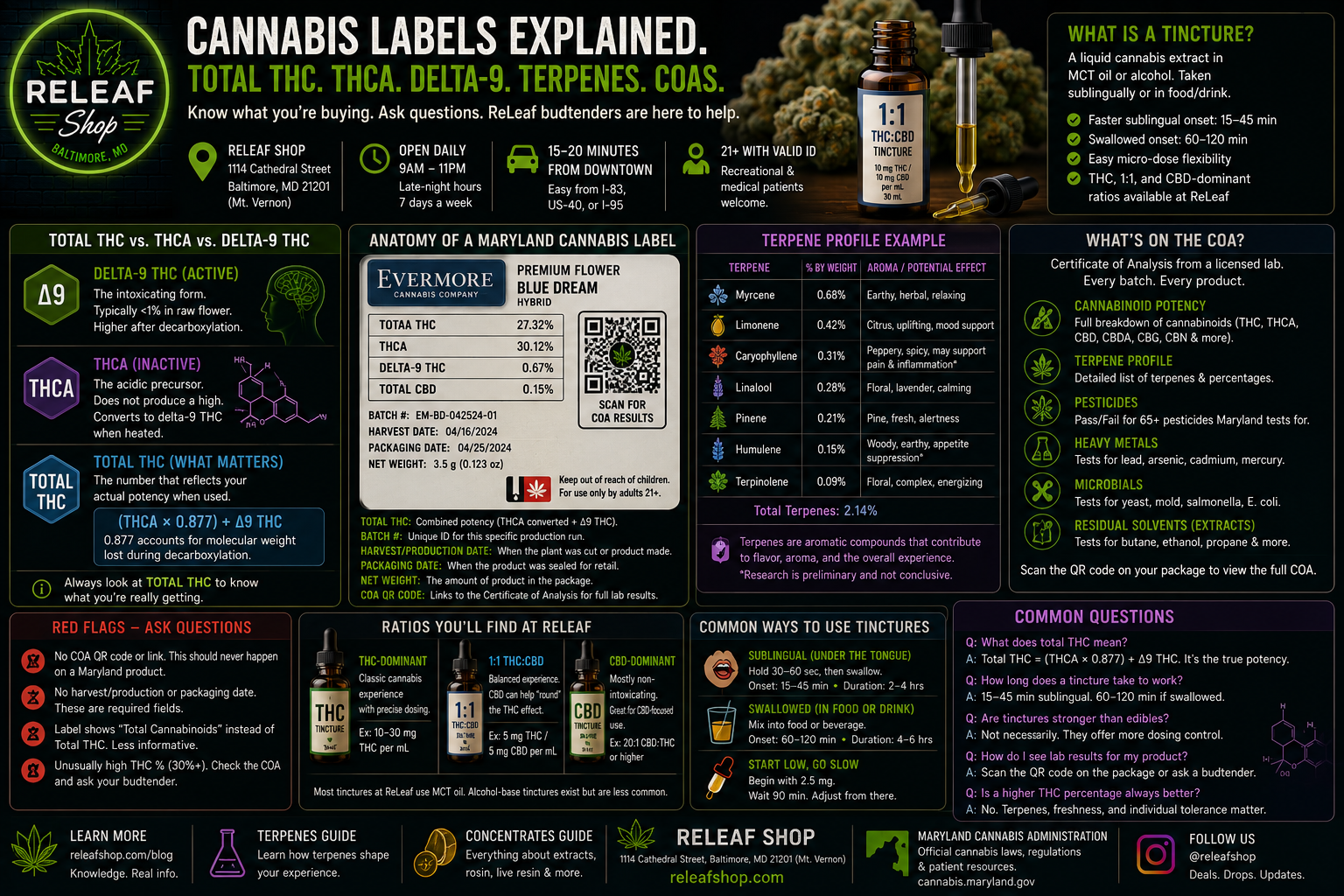
Total THC vs. THCA vs. delta-9 explained. Terpene profiles, batch numbers, harvest dates, COA links. What every section of a Maryland label means.

Every cannabis product sold legally in Maryland carries a regulated label: total THC, total CBD, batch number, harvest date, packaging date, and a link to the Certificate of Analysis from the licensed testing lab. The COA is the document that proves the product was tested for pesticides, heavy metals, microbials, and residual solvents. ReLeaf Shop budtenders in Baltimore are trained to walk customers through any label and pull up the COA on request. This post breaks down what every section of a Maryland cannabis label actually means.
A compliant Maryland cannabis label has a fixed set of required fields. The most-important sections from a buyer's perspective:
Total THC. The combined potency figure, usually as a percentage for flower and as milligrams for edibles and concentrates. Includes both delta-9 THC (the active form) and THCA (the inactive form that converts to THC when heated).
Total CBD. Same convention. Most Maryland flower has trace CBD; CBD-dominant products list higher numbers here.
Batch number. A unique identifier for the specific run of product. The batch number is what ties the package on your shelf to the COA on the testing lab's server.
Harvest date (flower) or production date (extracts, edibles). When the plant was cut or when the product was made. Maryland flower retains potency well for several months in sealed packaging; older flower is not necessarily worse but the terpene profile may have shifted.
Packaging date. When the product was sealed for retail. Combined with the harvest date, gives a curing window.
Net weight. Grams of cannabis product. The number that determines how much you're buying.
COA link or QR code. The Certificate of Analysis is a separate document hosted on the testing lab's website. Most Maryland labels include a QR code that pulls up the full COA on a phone scan.
Maryland Cannabis Administration rules require all of these for legal retail product. The full regulatory text is at cannabis.maryland.gov.
This is the most-confused section of a flower label and worth understanding. The three numbers:
Delta-9 THC. The active, intoxicating form. In a freshly-harvested flower it's typically below 1%; in a properly cured flower it climbs into the low single digits as some THCA converts.
THCA (tetrahydrocannabinolic acid). The inactive form. Doesn't produce a high in its raw state. When heated (lit, vaped, baked) THCA decarboxylates into delta-9 THC. Maryland flower labels typically show THCA in the 15% to 30% range.
Total THC. A regulatory calculation: (THCA × 0.877) + delta-9 THC. The 0.877 multiplier accounts for the molecular weight lost when THCA decarboxylates. This is the number that tells you what the flower's potency will actually be after you smoke or vape it.
If you only look at one potency number on a flower label, look at Total THC. The THCA-and-delta-9 breakdown is useful context but the combined Total THC is the practical figure.
Many Maryland flower labels include a terpene panel — a list of the dominant aromatic compounds in the specific batch. The most-named terpenes:
Myrcene. Earthy, herbal, slightly fruity. Most-abundant terpene in many indica-leaning cultivars.
Limonene. Citrus, bright. Common in sativa-leaning cultivars.
Caryophyllene. Pepper, spice. The only terpene that binds to a cannabinoid receptor (CB2), which is why it shows up in pain-and-anti-inflammatory cannabis research often.
Linalool. Floral, lavender. Less common but distinctive when it appears in higher percentages.
Pinene. Pine, fresh. Often associated with focus-leaning effect profiles.
Terpinolene. Floral, complex. Higher in some sativa-leaning cultivars.
The combined terpene percentage on most Maryland flower is between 1% and 3% of total weight — small numbers, big experience differences. Our terpenes guide covers each terpene in detail.
The Certificate of Analysis is the lab's detailed test report. Scanning the QR code on a Maryland cannabis package pulls it up on your phone. The COA typically includes:
Cannabinoid potency. The full breakdown — delta-9 THC, THCA, CBD, CBDA, CBG, CBGA, CBN, CBNA, THCV, and trace cannabinoids. Most Maryland labs report 11 or 12 cannabinoid numbers.
Terpene profile. Full terpene panel, typically 20 to 40 named compounds.
Pesticide screen. Pass/fail (or specific levels) for the pesticides Maryland requires testing on. A "pass" or "ND" (not detected) is what you want to see.
Heavy metals. Pass/fail for lead, arsenic, cadmium, mercury. Same convention.
Microbials. Yeast, mold, salmonella, E. coli. Maryland sets specific thresholds; the COA shows whether the batch passed.
Residual solvents. Required on concentrate COAs. Tests for butane, ethanol, propane, and other extraction-related solvents. Solventless extracts (live rosin) skip most of this section.
The COA is what separates a regulated Maryland product from a gas-station "hemp-derived" product. The testing isn't optional — every batch of legal cannabis at ReLeaf has one.
What to watch for and what to ask a budtender about:
No COA link or QR code. Should never happen on a Maryland dispensary product. If it does, ask the budtender.
"Total cannabinoid" listed instead of Total THC. Older convention. Less informative. Ask the budtender to pull the COA for the THC-specific number.
No harvest or production date. Required field on Maryland labels. If missing, flag it.
THC percentage that seems unusually high. Maryland flower legitimately tests above 30% Total THC occasionally, but most quality flower is in the 20% to 28% range. Outlier-high numbers are worth checking the COA for; lab calibration error is rare but real, and some testing labs run slightly hotter than others.
Most Maryland brands host their COAs on the brand's website or on the testing lab's portal. A scan of the QR code on the package will usually take you directly to the document. Brand-side, the Maryland-based growers ReLeaf carries (including Evermore, SunMed Growers, Curio Cannabis, and Fade Co) all comply with Maryland's COA-availability requirement.
For broader product context, our cannabis flower in Baltimore guide covers grading and the concentrates guide covers what to expect on a concentrate COA.
Total THC is the regulatory calculation that combines the active delta-9 THC and the inactive THCA in a single number: (THCA × 0.877) + delta-9 THC. This is the potency figure that reflects what the cannabis will actually deliver when smoked, vaped, or baked. The 0.877 multiplier accounts for the molecular weight lost when THCA decarboxylates into THC.
A Certificate of Analysis is the lab's detailed test report for a specific batch of cannabis product. It includes cannabinoid potency, terpene profile, pesticide screen, heavy-metals test, microbial test, and (for concentrates) residual-solvents test. Maryland requires a COA for every legal cannabis batch, and most package labels include a QR code that pulls up the full COA on your phone.
No. Total THC is one factor among several that determine the cannabis experience. Terpene profile, freshness, curing quality, and individual user tolerance all matter. Most experienced cannabis customers cite specific terpene profiles and cultivar reputation more than peak THC numbers when picking flower.
Scan the QR code on the product package with your phone camera. The QR code links to the Certificate of Analysis hosted by the testing lab. If the package doesn't have a QR code (rare), ask a ReLeaf budtender — they can pull up the COA from the brand's portal.
THCA is the inactive acid form of the cannabinoid as it exists in the raw plant. Delta-9 THC is the active intoxicating form. THCA converts to delta-9 THC when heated (smoked, vaped, baked into an edible) through a process called decarboxylation. Maryland flower labels typically show high THCA (15% to 30%) and low delta-9 THC (below 1%) because the raw flower hasn't been decarbed yet.
Regulatory framework: Maryland Cannabis Administration on labeling and testing requirements. Cannabis science: published research on cannabinoid decarboxylation. ReLeaf coverage: cannabis flower in Baltimore guide, terpenes guide, concentrates guide, cannabis brands.