Order Online
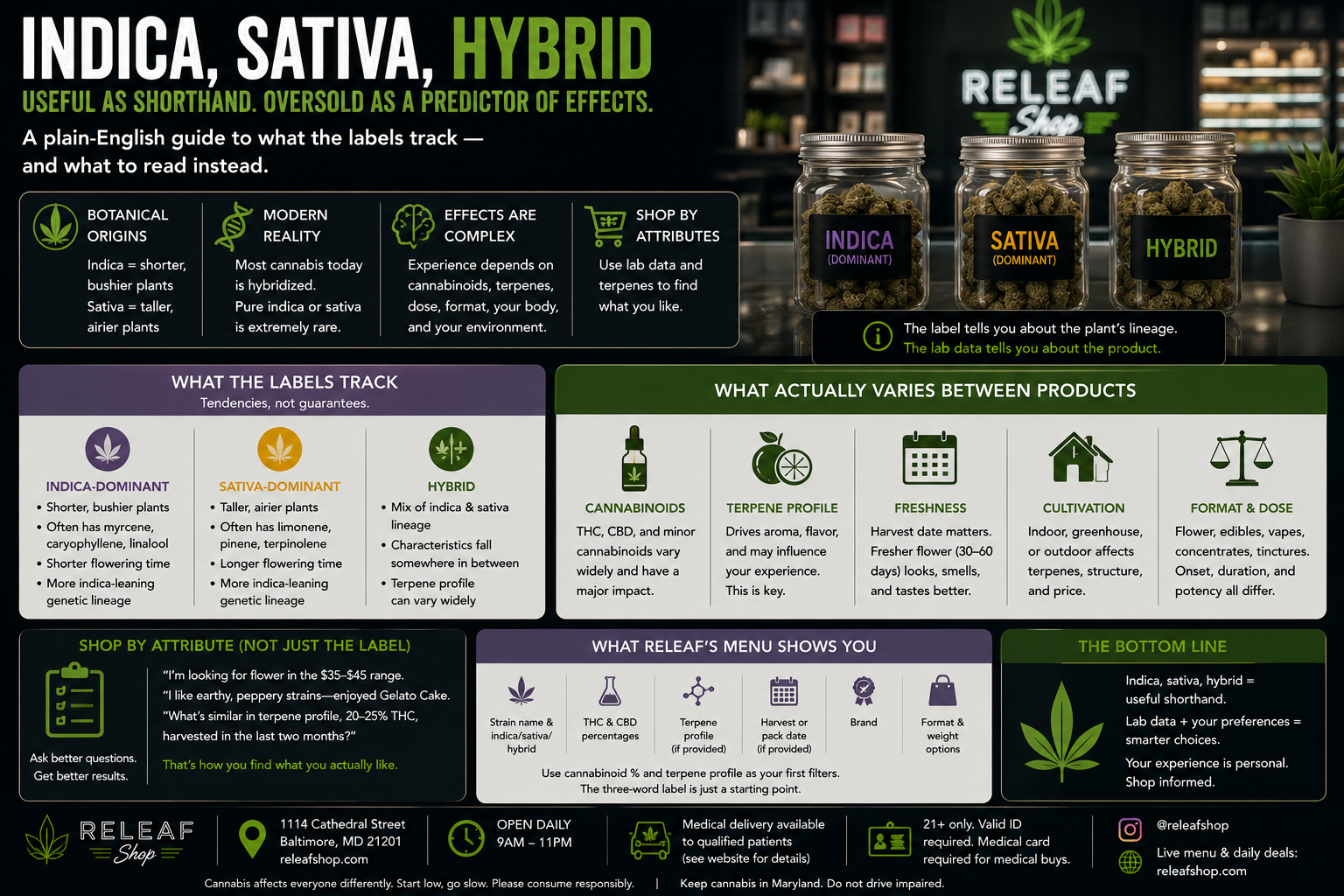
Indica, sativa, hybrid — useful as shorthand, oversold as a predictor of effects. A plain-English guide to what the labels track and what to read instead.

Every Baltimore dispensary menu sorts cannabis into indica, sativa, or hybrid. They're the first three words most new shoppers learn, and arguably the most oversimplified labels in the category. This is what they actually mean, what modern genetics did to those distinctions, and how to shop by attribute instead.
New to the three categories? Start with our full indica vs sativa vs hybrid guide, then come back here for what the labels do and don't tell you.
The classification traces back to 18th-century botany. Taxonomists noticed that cannabis plants from different regions had distinctly different growth habits. Cannabis indica — largely from the Hindu Kush mountains and surrounding areas — grew shorter and bushier, with broader leaves and faster maturation. Cannabis sativa — from equatorial regions in Southeast Asia, Central America, and Africa — grew taller and thinner, with narrower leaves and longer flowering cycles.
The classification was agricultural. It described the plant, not the experience of consuming it. Over centuries — and especially during the last few decades of legal and legacy cultivation — those geographic lines blurred. Modern cannabis is overwhelmingly hybridized. Pure indica or pure sativa genetics are rare in legal markets. What you're actually buying when you grab an "indica" jar is almost always a cross that leans indica-dominant in terpene profile and morphology.
Somewhere along the way, retail culture turned the botanical classification into shorthand for effects. Indica became "couch-lock," sativa became "head high," hybrid became "balanced." That shorthand isn't botanically accurate — it isn't really accurate at all. Individual experience is driven by a stew of factors: cannabinoid content (THC, CBD, minor cannabinoids), terpene profile, dose, format, set and setting, individual biochemistry, and recent cannabis exposure. The indica/sativa label captures almost none of that.
This is also why, at a compliance-reviewed Maryland dispensary like ReLeaf Shop, budtenders describe cannabis in attribute terms — format, cannabinoid percentage, terpene profile — rather than promising specific effects. Compliance is part of it. Accuracy is the rest.
Modern cannabis has been measured and sequenced at scale. When a brand labels a strain "indica-dominant," that typically means:
Plant morphology (growth habits) leans indica.
Terpene profile often features myrcene, caryophyllene, or linalool — earthier, spicier, more herbal aromas.
Flowering cycle is shorter.
Genetic lineage includes a higher proportion of historically-indica parents.
"Sativa-dominant" reverses each of those: morphology leans sativa, profile often features limonene, pinene, or terpinolene (citrus, pine, floral), flowering is longer, and lineage leans sativa.
"Hybrid" means neither lean dominates — or that the brand genuinely hasn't bucketed the strain.
These are tendencies, not guarantees. You can find indica-dominant strains with high limonene. You can find sativa-dominant strains with high myrcene. The label is a rough directional signal, not a predictive tool.
Things that do meaningfully differ from product to product:
Cannabinoid percentages. THC content can range from roughly 15% at the low end to over 30% at the premium-potency top of the market. CBD content varies widely — most recreational flower is low-CBD, but CBD-forward and balanced-ratio strains are available.
Terpene profile. The aromatic compounds in cannabis flower. A strain's dominant terpenes substantially influence its scent and flavor — and arguably influence the subjective experience, though terpene-effect research is still developing.
Harvest date and freshness. Flower is a plant product. Fresh flower (within 30 to 60 days of harvest) holds aroma and texture better than older flower. Harvest date is on the label at most Maryland dispensaries.
Cultivation method. Indoor, greenhouse (like SunMed Growers' Dutch-style facility in Warwick, MD), or outdoor. Method affects terpene retention, bud structure, and price.
Format. Flower behaves differently than pre-rolls, edibles, vapes, concentrates, or tinctures. Onset time, delivery mechanism, and duration vary meaningfully.
Brand and lot. Same strain from two different growers often produces noticeably different flower. Brand-level quality control matters.
A useful budtender conversation at ReLeaf sounds something like this:
"I'm looking for flower in the $35 to $45 per eighth range. I like earthy, peppery strains — I've had Gelato Cake in the past and enjoyed it. What do you have that's similar on terpene profile, with a 20 to 25% THC range and a harvest date in the last two months?"
That's attribute-based shopping. You'll walk out with flower that matches what you actually like.
Compare it to: "What's a good indica?" The budtender can only point at jars labeled indica-dominant. You may get something you don't like, and the label told you nothing about why.
The ReLeaf Shop menu — powered by Dutchie — surfaces strain details including:
Strain name and indica/sativa/hybrid classification (for reference). THC and CBD percentages. Terpene profile breakdown for brands that publish it. Harvest or pack date where producer-provided. Brand. Format and weight options.
For most shoppers, the first two filters worth pulling up are cannabinoid percentage and terpene profile. Those tell you materially more than the three-word category heading. For a deeper read on terpenes specifically, see our guide to cannabis terpenes.
Not useless. A directional tool, especially for new shoppers who haven't calibrated what they like yet. If indica-labeled strains you've tried have consistently had profiles you enjoyed, that's useful shorthand — it captures your history with the label rather than a botanical truth.
For repeat shoppers who've learned what terpenes and cannabinoid ratios work for them, the label becomes almost irrelevant. You're buying for the profile, not the heading.
Historically, indica and sativa described cannabis plant types with different growth patterns. Indica plants were shorter and bushier, while sativa plants were taller and thinner. In today’s legal cannabis market, most strains are hybrids, so the labels are better treated as rough shorthand than exact predictors of effects.
No. Indica-labeled strains often lean toward earthier or heavier terpene profiles, but they are not guaranteed to feel relaxing for every user. Effects depend on cannabinoids, terpenes, dose, format, freshness, and individual body chemistry.
No. Sativa-dominant labels can suggest citrus, pine, or floral terpene profiles, but they do not guarantee energy or focus. A high-THC sativa can feel overwhelming for some users, while a lower-dose hybrid may feel more functional.
No. Hybrid simply means neither indica nor sativa clearly dominates, or that the brand is using a broad middle category. A hybrid can lean 60/40, 70/30, or be labeled as indica-dominant or sativa-dominant depending on the producer.
The label is useful as a starting point, especially for newer shoppers, but it should not be the only thing you use. Terpene profile, cannabinoid percentage, harvest date, format, and brand usually tell you more than the indica/sativa/hybrid heading.
Look at THC percentage, CBD percentage, terpene profile, harvest or pack date, product format, brand, and weight options. These attributes give a clearer picture of what you are buying than the three-word strain category alone.
Modern cannabis has been heavily crossbred over decades of legal and legacy cultivation. Pure indica or pure sativa genetics are rare in today’s dispensary market, so most products are hybridized even when they lean one direction.
Indica-dominant usually means the strain’s genetics, plant structure, flowering cycle, or terpene profile leans toward historically indica traits. It does not mean the product will automatically make every shopper sleepy or sedated.
Sativa-dominant usually means the strain’s lineage, plant morphology, flowering cycle, or terpene profile leans toward historically sativa traits. It is a directional signal, not a guarantee of energy, creativity, or focus.
Indica-dominant strains often feature terpenes like myrcene, caryophyllene, and linalool, which can bring earthier, spicier, or more herbal aromas. But terpene profiles vary by strain, grower, and batch.
Sativa-dominant strains often feature terpenes like limonene, pinene, and terpinolene, which can create citrus, pine, or floral aromas. These are tendencies, not fixed rules.
THC percentage is more specific than the indica/sativa label, but it still does not tell the whole story. A product’s overall experience also depends on CBD, minor cannabinoids, terpene profile, format, dose, and the user’s tolerance.
The same strain can feel different when grown by different cultivators or harvested in different batches. Brand-level quality control, terpene retention, freshness, and cultivation method can all change the final product.
Attribute-based shopping means choosing cannabis based on what actually varies between products: terpene profile, cannabinoid percentage, harvest date, format, price range, and brand. It is more precise than simply asking for “a good indica” or “a good sativa.”
Ask for specifics, such as: “I’m looking for flower in the $35–$45 range, with an earthy or peppery terpene profile, around 20–25% THC, and a recent harvest date.” That gives the budtender useful attributes to match instead of relying on a broad label.
Indica, sativa, and hybrid are useful as shorthand — not as prescriptions. The real shopping conversation is about terpene profile, cannabinoid percentage, harvest date, format, and brand. Ask a ReLeaf budtender to walk you through those attributes, and the three-word category heading becomes one data point among many.
Browse the live menu and filter by terpene profile or cannabinoid content.