Order Online
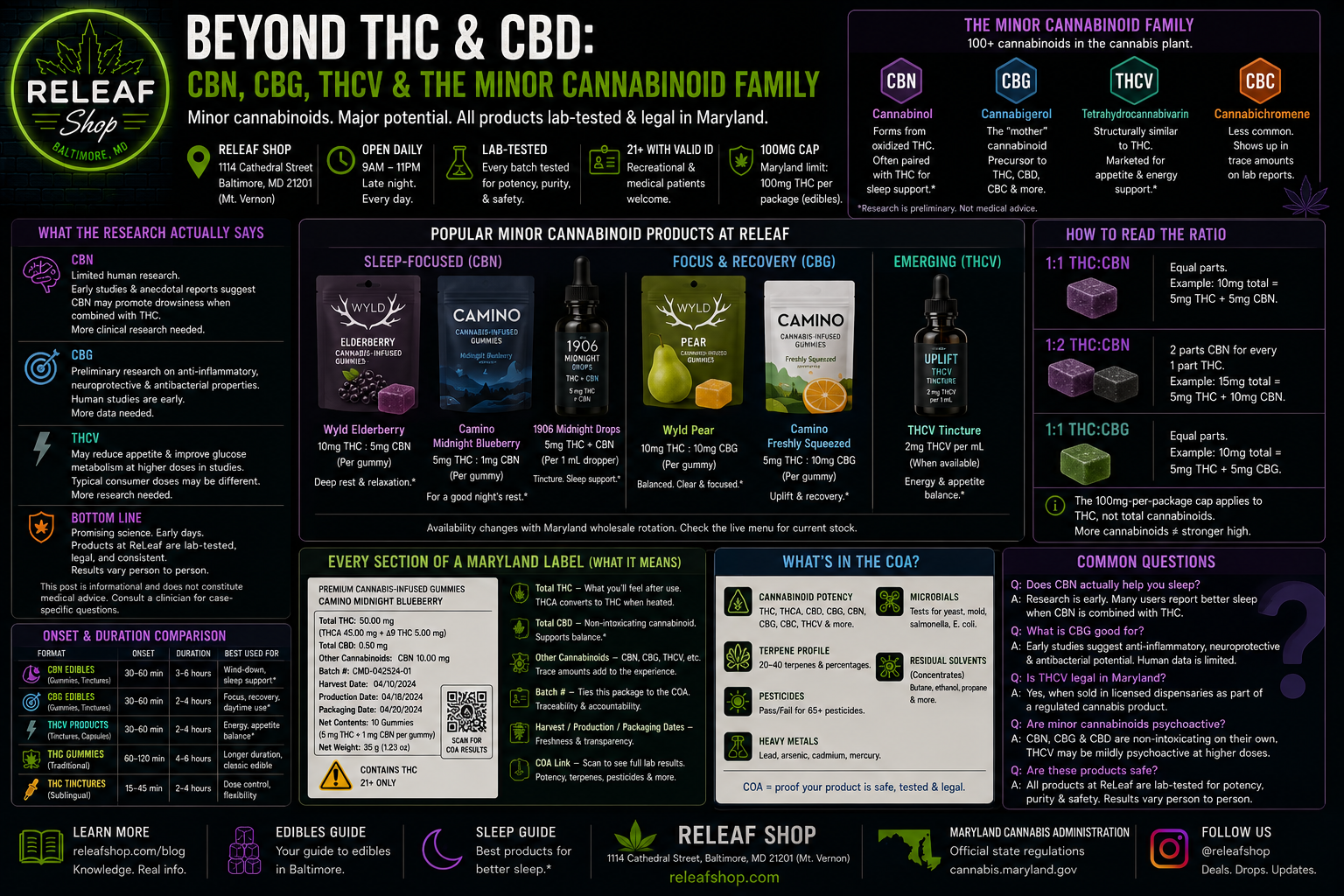
CBN, CBG, THCV, and the minor cannabinoid family at ReLeaf. Wyld Elderberry, Camino Midnight Blueberry, 1906 Midnight. What the research actually says.

CBN (cannabinol) and CBG (cannabigerol) are two of the most-discussed minor cannabinoids in the cannabis plant. Both are present in much smaller quantities than THC or CBD but are increasingly isolated into dedicated products. ReLeaf Shop in Baltimore stocks gummies, tinctures, and chocolates featuring CBN, CBG, and combination ratios across rotating Maryland brands. Maryland law treats these products the same as THC products at the retail level. This post is informational and does not constitute medical advice.
Cannabis sativa produces over 100 cannabinoids. Most are present in trace amounts; THC and CBD dominate the conversation because they're the most abundant. The minor cannabinoids that have moved into Maryland retail in 2026:
CBN (cannabinol). Forms when THC oxidizes — typically in older cannabis flower or through deliberate oxidation in extraction. Often paired with THC in sleep-focused edibles.
CBG (cannabigerol). Sometimes called the "mother cannabinoid" because it's the precursor that converts to THC, CBD, and CBC during the plant's growth. Marketed in products positioned around focus and recovery.
THCV (tetrahydrocannabivarin). Structurally similar to THC but with different effects at typical doses. Marketed in products positioned around appetite regulation, though the research is preliminary.
CBC (cannabichromene). Less commercially developed than the above three. Shows up in trace amounts on COA panels.
Published research on minor cannabinoids covers what's actually known. The honest answer for most of these compounds: the research is real but early, and the marketing tends to outrun the science.
CBN is the most-asked-about minor cannabinoid at ReLeaf in 2026. It's typically paired with THC in 1:1 or higher ratios — Wyld Elderberry (10mg THC + 5mg CBN), Camino Midnight Blueberry (5mg THC + 1mg CBN), 1906 Midnight Drops (5mg THC + CBN). The CBN-forward formulations cluster around sleep-leaning messaging.
Patterns we hear, paraphrased and not as medical guidance: customers asking about CBN often describe interest in sleep-leaning edibles or in cannabinoids that aren't THC-dominant. The question that comes up most is "does CBN actually do anything different from just taking more THC?" The honest answer is the research on CBN's distinct effects is still developing, and the customer reports are mixed. Some shoppers describe a meaningful difference; others don't. We sell the product because Maryland brands make it and customers ask for it, not because we can make therapeutic claims about it.
CBG sits earlier in the cannabis plant's biosynthesis pathway than THC or CBD — the plant produces CBG first, then converts most of it to other cannabinoids during growth. The marketing positioning leans on this "stem-cell" framing.
CBG-forward products at ReLeaf include Wyld Pear (10mg THC + 10mg CBG) and Camino Freshly Squeezed (5mg THC + 10mg CBG). Both are positioned around recovery or focus rather than sleep. The customer-side conversation usually focuses on shoppers who've tried CBN sleep products and want to try a different minor-cannabinoid blend for a different time of day.
The research on CBG is similar to CBN: real but early, with marketing claims running ahead of established findings. Project CBD's CBG page is a reasonable starting point for the published research.
THCV is structurally similar to THC but with notable pharmacological differences. The popular marketing claim that THCV reduces appetite where THC famously stimulates it has some research support but is not settled science. The compound has been studied in higher-dose contexts; what the consumer doses in a typical THCV product actually produce is less clearly established.
THCV products at ReLeaf are rare in 2026. The compound is harder to source and isolate than CBN or CBG. When THCV products do ship into Maryland, they tend to be in tincture or capsule format and at higher price points than standard cannabinoid edibles.
The category-by-format breakdown:
CBN edibles. Most common minor-cannabinoid retail product. Wyld Elderberry, Camino Midnight Blueberry, 1906 Midnight Drops — all in the sleep-forward positioning. Our best strains for sleep guide covers the broader sleep-category at ReLeaf.
CBG edibles. Smaller category. Wyld Pear and Camino Freshly Squeezed are the most-consistent. Tincture formats occasionally rotate in.
Blended minor-cannabinoid tinctures. Several Maryland brands offer THC + CBN tinctures, THC + CBG tinctures, and tri-cannabinoid blends. Tinctures are easier to micro-dose than gummies, which matters when calibrating to a minor cannabinoid.
CBD-CBN-CBG flower. Rare. Maryland flower is overwhelmingly THC-dominant; the minor-cannabinoid category lives mostly in extracted formats.
The Baltimore edibles buyer's guide covers the broader category, and the cannabis for sleep guide goes deeper on the sleep-leaning use case where CBN is most often asked about.
A 1:1 THC:CBN gummy with 10mg total per piece typically means 5mg THC and 5mg CBN. A 1:2 THC:CBN means 1 part THC to 2 parts CBN by weight. For a 15mg-total piece, that's 5mg THC and 10mg CBN. The Maryland 100mg-per-package cap applies to total THC equivalents, not to total cannabinoids of all kinds, so a CBN-heavy product can have more total cannabinoids in the pack than a THC-only product.
The COA pulled from the QR code on the package will list each cannabinoid separately. Our cannabis flower in Baltimore post covers how to read a COA. The same principles apply to edible labels in the minor-cannabinoid category.
CBN is cannabinol; CBD is cannabidiol. Different cannabinoids with different pharmacology. CBN typically forms from oxidized THC and is marketed in sleep-forward products. CBD is naturally abundant in cannabis and is more associated with anti-inflammatory and non-intoxicating effects. Both are non-intoxicating on their own, but they're not interchangeable products.
Customer reports from Baltimore shoppers are mixed. Some describe a meaningful difference from CBN-blended products versus THC-only sleep formulations; others don't. The published research on CBN's distinct sleep effects is still developing — what's well-established is that THC + CBN combinations are widely used by sleep-focused customers, but the specific CBN contribution is less proven than the marketing suggests. This is informational; not medical advice.
CBG is marketed in products positioned around recovery, focus, and general wellness. The research is preliminary; the customer reports vary. CBG products at ReLeaf are most commonly blended with THC at 1:1 ratios (Wyld Pear, Camino Freshly Squeezed).
Yes. CBN-blended gummies are one of the most consistently stocked minor-cannabinoid categories at ReLeaf. Wyld Elderberry, Camino Midnight Blueberry, and 1906 Midnight Drops are the most-asked-about CBN products on the Maryland menu.
At the retail level, no. Maryland regulates cannabis products as a category — THC content drives the regulatory framework, with the 100mg-per-package cap on edibles and the lab-testing requirements applying to any product sold through licensed dispensaries. CBN, CBG, THCV, and other minor cannabinoids in dispensary products go through the same testing and labeling requirements as THC.
Research and regulation: published research on minor cannabinoids, Project CBD on CBG, Maryland Cannabis Administration. ReLeaf coverage: best strains for sleep, cannabis for sleep guide, Baltimore edibles guide, terpenes guide.
This post is informational and does not constitute medical advice. Consult a clinician for case-specific questions about cannabinoids and your health.