
Order Online
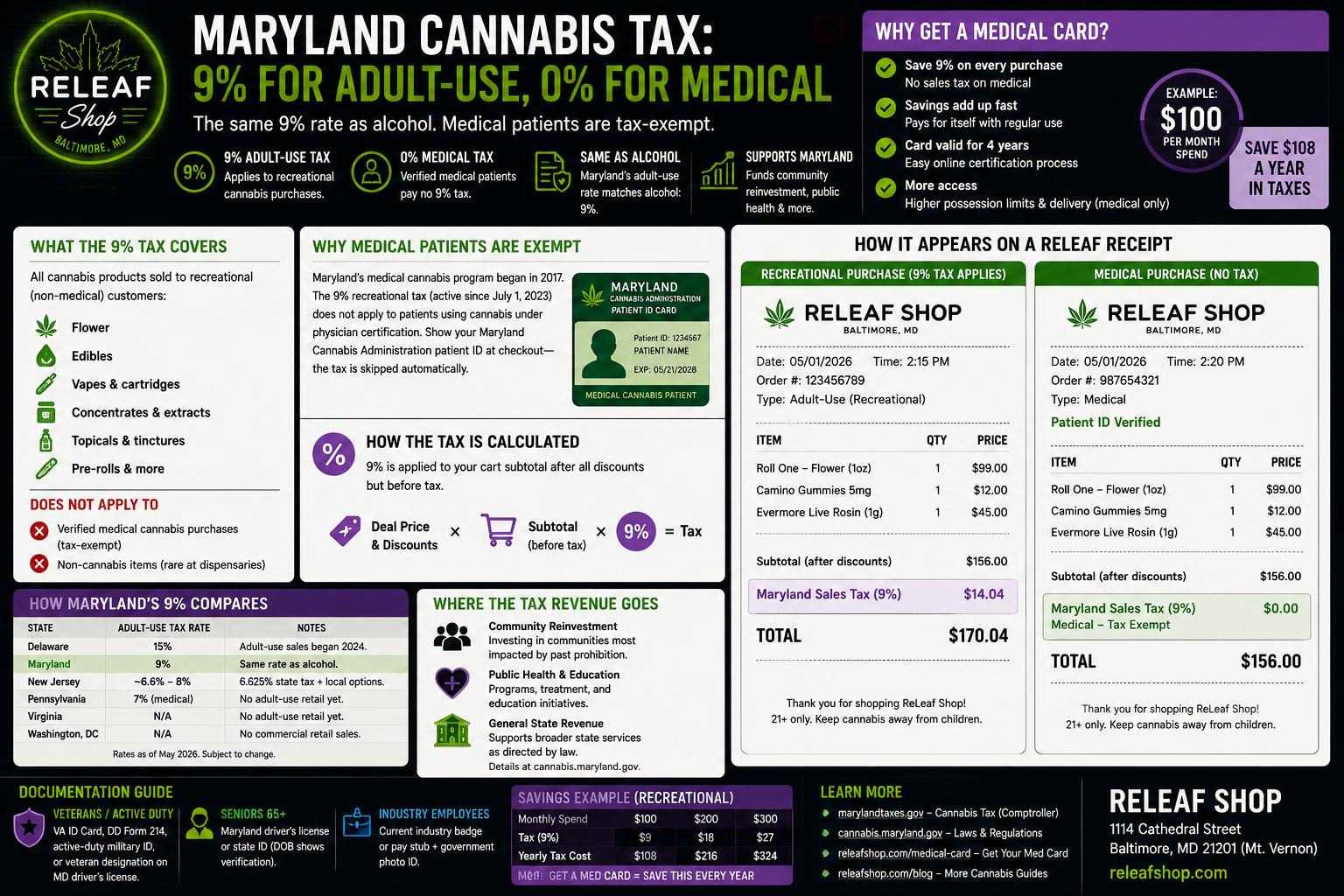
Maryland's adult-use cannabis tax is 12%, raised from 9% on July 1, 2025. Medical patients are exempt. How the tax appears on a ReLeaf receipt.

Maryland's adult-use (recreational) cannabis sales tax is 12% — raised from 9% effective July 1, 2025, and now above the state's 9% alcohol sales tax. Medical cannabis purchases are tax-exempt under the state's medical program. At ReLeaf Shop in Baltimore, the 12% appears as a separate line on every recreational receipt and is not applied to qualified medical patient orders. For shoppers who buy regularly, the tax math is the largest single argument for getting the medical card.
Maryland's adult-use cannabis sales tax took effect July 1, 2023, when recreational sales began, at an initial statutory rate of 9%. Effective July 1, 2025, the rate rose to 12% of the retail sale price before tax — above the 9% sales tax Maryland applies to alcoholic beverages. The tax is collected at the dispensary register, reported by the dispensary, and remitted to the Maryland Comptroller.
What the tax applies to:
Cannabis product sales. Flower, edibles, vapes, concentrates, topicals, pre-rolls, tinctures — every retail cannabis SKU sold to a recreational (non-medical) customer.
The pre-tax retail price. The 12% applies to the post-discount, pre-tax cart subtotal. Loyalty redemption, daily deal pricing, and eligibility discounts all reduce the base before the 12% is calculated.
What the tax doesn't apply to:
Medical cannabis purchases. Verified Maryland medical patients don't pay the 12% on their purchases.
Accessories (where dispensaries sell them). Maryland regulations limit dispensaries to cannabis products primarily, so accessory exemption is rarely a factor.
The Maryland Comptroller publishes the regulatory framework at marylandtaxes.gov; the cannabis-specific guidance is available through the Maryland Cannabis Administration.
Maryland's medical cannabis program is older than the adult-use program (medical began in 2017, adult-use in 2023). When the recreational tax was set up, Maryland kept the medical program tax-exempt to preserve patient access. The policy intent was straightforward: people using cannabis under physician certification shouldn't face the same revenue-driven tax as adult-use consumers.
To claim the medical exemption at checkout, the patient presents their Maryland Cannabis Administration patient ID alongside their government photo ID. The dispensary's point-of-sale system routes the transaction through the medical workflow, which skips the 12% line. The exemption is automatic once verified — no separate form, no separate process.
For more on getting the medical card, our how to get a Maryland medical cannabis card post walks through the two-week certification process.
A ReLeaf recreational receipt typically shows:
Subtotal. The sum of cannabis product line items at their post-discount price.
State sales tax (12%). Calculated against the subtotal. Listed as a separate line.
Total. Subtotal + tax = total amount due.
A medical patient receipt skips the tax line entirely. The subtotal equals the total (minus loyalty or eligibility-discount adjustments). The receipt clearly indicates "Medical" or "Patient ID" somewhere on the printout to distinguish from recreational sales.
Maryland's 12% adult-use cannabis tax is in the middle of the regional band. For comparison, as of 2026:
Pennsylvania. No adult-use program yet; medical-only with a 7% state tax that's discounted for patients in practice.
Washington, DC. Cannabis is legal to possess but not sold through commercial retail under the local statute; the regulatory and tax structure remains in flux.
Virginia. Adult-use possession is legal; commercial retail sales are not yet active under the state's framework. No applicable adult-use retail tax until retail begins.
Delaware. Adult-use sales began in 2024 with a 15% retail tax (excise plus state sales tax components, depending on counting method).
New Jersey. Adult-use sales carry a 6.625% state sales tax plus a Social Equity Excise Fee that adds further. Effective rate around 6.625% to 8% depending on the local municipal cannabis tax.
Maryland's 12% — raised from the original 9% on July 1, 2025 — sits in the middle of the regional range: below the highest combined totals in the region, and higher than the no-retail-tax-yet states (PA, VA, DC).
Maryland's adult-use cannabis tax revenue is allocated to several state purposes by statute, including community reinvestment in communities disproportionately impacted by past cannabis prohibition, public health and education programs, and general state revenue. The exact allocation formulas are set in the Maryland Cannabis Reform Act and updated by the legislature as the program matures. Maryland Cannabis Administration publishes ongoing program reports.
The medical-card math is straightforward. For any monthly cannabis spend, the tax savings are 12% of the pre-tax total. A few example points:
$50/month spend. $72 a year tax saved. Approaches the cost of a single telehealth certification visit ($99 to $200).
$100/month spend. $144 a year tax saved. Pays for the certification within a year. Pays for it indefinitely thereafter (the card is valid four years).
$200/month spend. $288 a year tax saved. Pays for the certification within months and continues saving for the four-year card duration.
$300+/month spend. $432+ a year tax saved. The medical card more than pays for itself before the second renewal.
For anyone shopping cannabis regularly in Maryland, the math favors the medical card almost universally. The certification process is two weeks and mostly online. Our medical card guide walks through every step.
12% on adult-use (recreational) cannabis purchases. Medical patients are tax-exempt. The 12% applies to the post-discount, pre-tax subtotal at checkout and appears as a separate line on the receipt.
No. Verified Maryland medical patients are exempt from the 12% adult-use cannabis sales tax. The exemption applies automatically when the patient presents a valid Maryland Cannabis Administration patient ID at checkout.
For recreational adult-use customers, yes — but recreational delivery is not permitted under current Maryland rules, so this question rarely comes up in practice. Medical delivery is the only legal delivery format in Maryland, and medical patients are tax-exempt. So in effect, no delivery order at ReLeaf carries the 12%.
Maryland's 12% sits in the middle of the regional band. Delaware (15%) and New Jersey (around 7% to 8% depending on locality) are the closest comparison points with active adult-use retail. Pennsylvania, Virginia, and DC don't have comparable adult-use retail tax structures because their commercial retail markets aren't fully active yet.
Maryland statute directs adult-use cannabis tax revenue to several purposes including community reinvestment in communities disproportionately impacted by past prohibition, public health and education programs, and general state revenue. The Maryland Cannabis Administration publishes program reports tracking the allocations.
State sources: Maryland Comptroller on the adult-use cannabis tax, Maryland Cannabis Administration on the regulatory program. ReLeaf coverage: Maryland cannabis laws, medical vs. recreational in Maryland, how to get a Maryland medical cannabis card, how to legally buy cannabis in Maryland, Baltimore cannabis price comparison.
.jpeg)

.jpeg)