
Order Online
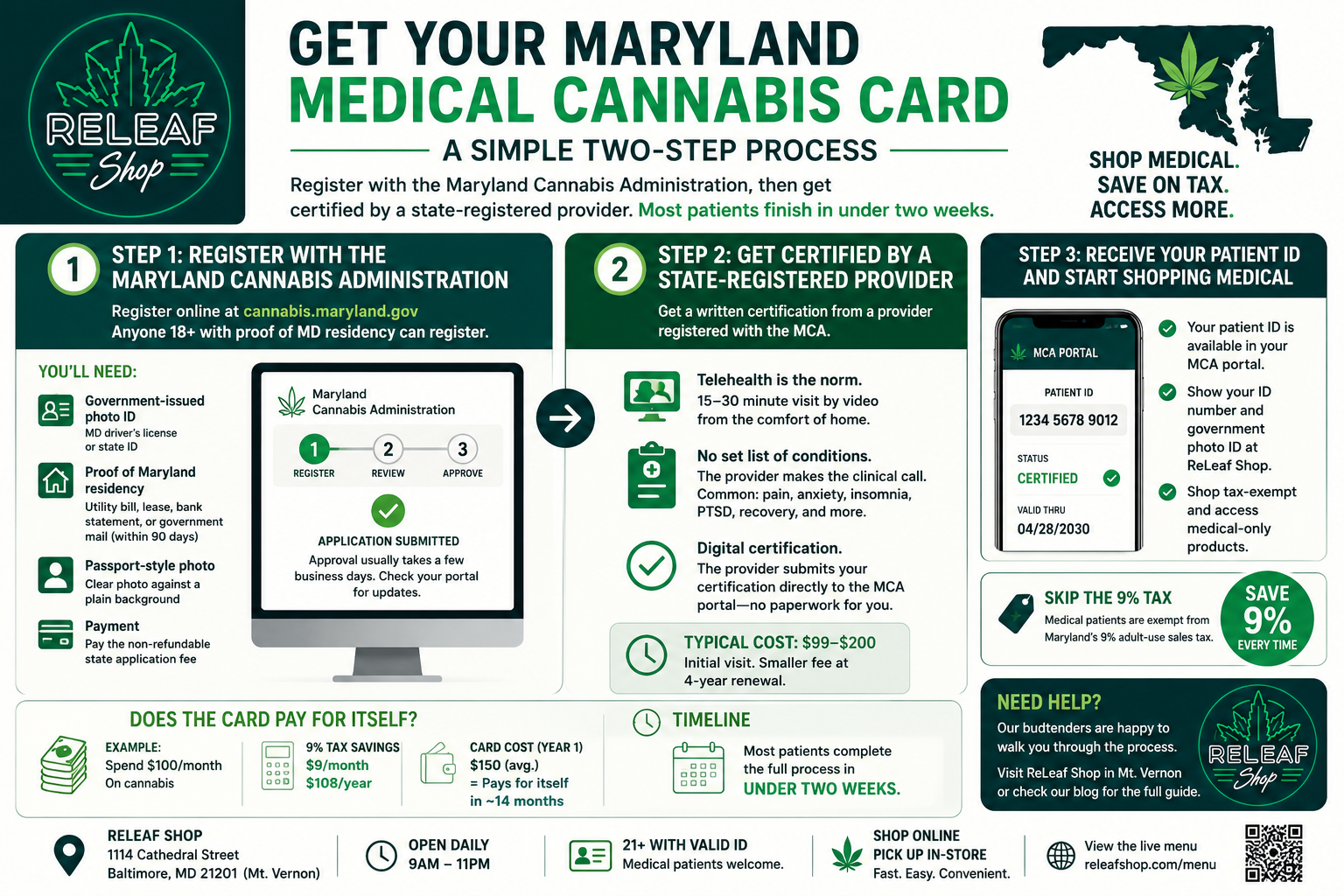
Two-step process: register with the Maryland Cannabis Administration, then get certified by a state-registered provider. Most patients finish in under two weeks.

Getting a Maryland medical cannabis card in 2026 is a two-step process: register as a patient with the Maryland Cannabis Administration, then get a written certification from a state-registered provider. Most Baltimore residents finish the full process in under two weeks, almost entirely online. Once issued, the patient ID skips the 12% adult-use sales tax on every cannabis purchase and gives you medical-only product access at ReLeaf Shop and other licensed Maryland dispensaries. This post walks through every step and the math on whether the card is worth it for how you actually shop.
The Maryland Cannabis Administration runs patient registration through its online portal. Anyone 18 or older with proof of Maryland residency can register. Patients under 18 require a designated caregiver and additional steps that are outside the scope of this guide.
Registration happens at cannabis.maryland.gov, on the patient portal. You'll create an account, upload your documents, and pay a state registration fee. Plan on about 20 to 30 minutes the first time through.
What the registration asks for:
Government-issued photo ID. A Maryland driver's license or state ID is the cleanest path. Out-of-state IDs are not accepted for resident registration; if you're a new Maryland resident, you'll need to update your ID before registering.
Proof of Maryland residency. Most patients use a recent utility bill, a lease, a bank statement, or any government correspondence with a Maryland address from the last 90 days.
Passport-style photo. The portal will accept a phone photo against a plain background. Avoid sunglasses, hats, or anything that obscures your face.
Payment. The state charges a non-refundable patient application fee. Have a credit or debit card ready.
Once submitted, the patient registration is usually approved within a few business days. The status updates in your portal account. Wait for approval before scheduling Step 2.
Maryland requires a written certification from a physician, nurse practitioner, dentist, podiatrist, or other licensed clinician who has registered with the Maryland Cannabis Administration as a certifying provider. Your regular primary care doctor may or may not be registered. The state maintains a public list of registered providers at cannabis.maryland.gov under the Patients section.
Most new Maryland patients in 2026 use a telehealth-first certifying clinic rather than booking with their existing physician. Telehealth providers operating in Maryland typically charge between $99 and $200 for the first certification visit and a smaller renewal fee at the four-year mark. The visit takes 15 to 30 minutes by video. The clinician reviews your medical history, talks through your interest in cannabis, and issues the written certification directly into the state portal if they conclude cannabis is appropriate for your case.
A few things to know about the certification visit:
Maryland does not maintain a list of qualifying conditions. Unlike some states, Maryland's medical cannabis statute does not restrict certification to a fixed list of diagnoses. The certifying provider makes the clinical call. The most-common cases certified in 2026 are chronic pain, anxiety, insomnia, PTSD, and post-surgical recovery, but the list is not exhaustive.
The certification is digital. No paper changes hands. The clinician submits the certification directly into the MCA portal under your patient ID.
Telehealth is the norm. Maryland law explicitly allows telehealth certification, and the post-2020 shift to virtual care made it the dominant path for new patients in Baltimore. In-person providers exist if you prefer a clinic visit.
Once the certification is filed, your status in the MCA portal updates to certified. The patient ID is a long string of digits unique to you, visible inside the portal account. You can show it on your phone or print it. Maryland does not require a physical plastic card; the digital ID is the credential.
Walking into ReLeaf Shop as a medical patient for the first time: bring your government photo ID and pull up your patient ID number on your phone. Tell the check-in associate that you're shopping medical. The system routes you to the medical workflow, which means tax-exempt pricing at checkout and access to medical-only inventory if anything in that category is in stock that day. Our medical dispensary post covers what medical-only access actually looks like at ReLeaf in practice — it's a smaller difference in 2026 than it was pre-2023, but it's still a difference.
The total out-of-pocket cost to become a Maryland medical patient in 2026 breaks into two pieces:
State registration fee. A one-time application fee paid to the Maryland Cannabis Administration during Step 1. Check the current amount in the portal during registration — the state has periodically adjusted the fee.
Provider certification fee. Paid to the clinician, not the state. Typical 2026 range is $99 to $200 for an initial certification via a telehealth clinic; some in-person primary care providers who are MCA-registered charge a standard office-visit copay through insurance instead.
The Maryland patient certification is valid for four years from issuance under the current rules. After four years, the provider has to recertify. Patient registration in the state portal does not expire on the same cycle — keep your contact information current to avoid administrative friction at renewal.
Here's the math, plainly. Maryland's adult-use cannabis sales tax is 12%. Medical patients are exempt from that tax under the state statute. If you spend $100 a month at a dispensary, the recreational tax is $12 a month, or $144 a year. If you spend $200 a month, the math doubles to $288 a year. The tax savings alone often cover the certification fee within a few months of regular shopping.
There's also a non-cash side to the math. The medical patient flow at ReLeaf is what gets you cannabis delivery for Baltimore-area patients. Under current Maryland rules, recreational delivery is not permitted; only medical. For a patient with mobility constraints, a busy schedule, or anyone who would just rather not park in Mt. Vernon during dinner rush, that's the real value of the card more than the 12%.
And one more piece of math: medical patients face fewer per-transaction limits than recreational customers, set by the certifying provider's 30-day supply allocation. The exact number depends on your provider's notation. For shoppers buying for chronic conditions or long-term wellness use, this matters at the register.
A few things the medical card does not change:
Federal law still applies. Cannabis is federally illegal regardless of Maryland's program. The card does not legalize cannabis on federal property, in federal employment, or across state lines. Our Maryland cannabis laws post goes into the federal-state interaction in detail.
Workplace drug testing. The medical card offers limited protections in some Maryland employment contexts but does not override safety-sensitive job requirements, federally regulated industries, or most private-sector drug-testing policies. Anyone weighing the card against their job situation should talk to an attorney; this post is informational, not legal advice.
Driving. Maryland DUI law applies to medical and recreational cannabis equivalently. The card is not a defense to driving impaired.
At the four-year renewal mark, the path is shorter than initial registration: a follow-up certification visit with a registered provider and an updated portal status. No re-registration with the state is required as long as your MCA account stays active.
Most Baltimore patients finish the full process in under two weeks. Patient registration with the state takes a few business days to approve. Once registered, a telehealth certification visit can usually be booked within a week. Once the certifying provider files the written certification, the medical ID is active immediately in the portal.
Total out-of-pocket cost in 2026 is the state's patient application fee plus the provider's certification fee. The provider fee is the variable piece — typical telehealth-clinic pricing runs $99 to $200 for an initial certification. The state fee is fixed; check the current amount in the patient portal during registration.
Yes. Maryland law explicitly allows telehealth certification, and the majority of new patient certifications in 2026 happen by video visit. The certifying provider must be registered with the Maryland Cannabis Administration; the visit itself can be virtual.
Yes. The Maryland Cannabis Administration requires a Maryland driver's license or state ID for patient registration. Out-of-state IDs are not accepted for resident certification. New Maryland residents need to update their ID with the MVA before registering as a patient.
Three benefits matter most. Medical patients are exempt from the 12% adult-use cannabis sales tax. Medical patients are the only ones eligible for cannabis delivery under current Maryland rules. And medical patients face fewer per-transaction limits than recreational customers, set by the certifying provider's allocation. For anyone shopping regularly, the math usually favors getting the card.
State sources: Maryland Cannabis Administration patient portal and registered provider list. Maryland Department of Health for general program context. Maryland Comptroller for the 12% adult-use sales tax citation. ReLeaf coverage of related topics: medical vs. recreational in Maryland, how to legally buy cannabis in Maryland, first-time dispensary visit.
This post is informational and does not constitute medical or legal advice. Consult a Maryland-registered certifying provider for your specific medical situation and an attorney for case-specific legal questions.
.jpeg)
.jpeg)