Order Online
Yes, ReLeaf is a Maryland medical dispensary — and it's also licensed for recreational. What changes between the two paths.

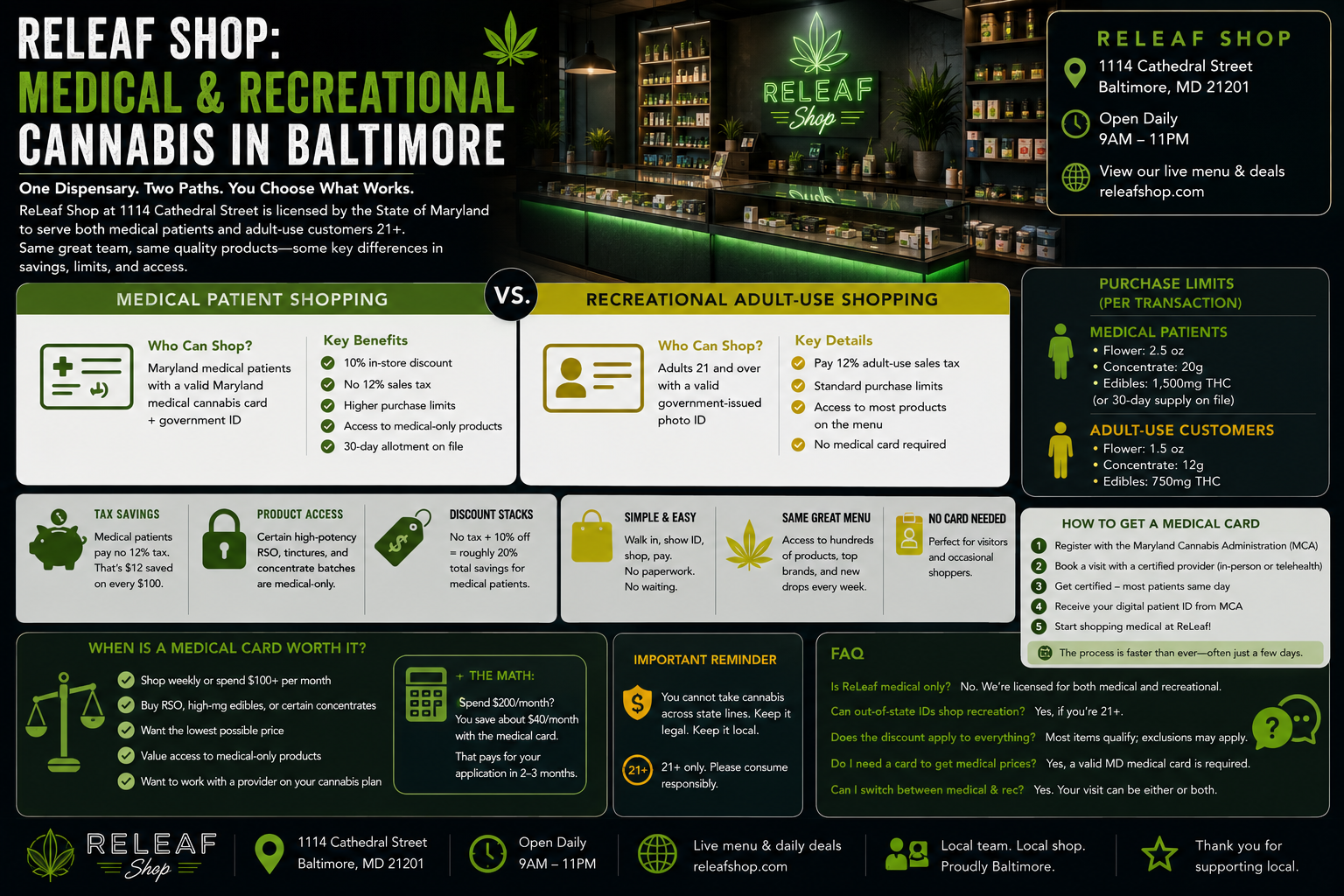
Yes. ReLeaf Shop is a licensed Maryland dispensary serving both medical patients and adult-use recreational customers. Medical patients with a valid Maryland medical card receive a 10% in-store discount and have access to higher purchase limits per transaction. Adult-use customers age 21 and up can shop with a valid government-issued photo ID. Both groups walk in the same door at 1114 Cathedral Street, Baltimore.
The Maryland recreational launch in July 2023 changed how dispensaries are organized — most went from medical-only to dual-use. ReLeaf is one of those dual-licensed shops. Below is the practical breakdown of what changes between the two paths.
The biggest differences sit in three places: tax, purchase limits, and product access.
Tax. Recreational sales are taxed at 12% under Maryland's adult-use program. Medical purchases are not subject to that 12% surcharge. On a $100 order, that's a $12 swing.
Purchase limits. Recreational customers can buy up to 1.5 ounces of flower, 12 grams of concentrate, or 750mg of THC in edible form per single transaction. Medical patients have higher limits and can build a 30-day supply on file with their dispensary.
Product access. Some products — typically high-potency RSO, certain medical-leaning tinctures, and a small number of concentrate batches — are reserved for medical patients only. The bulk of the menu is open to both.
ID at the counter. Recreational customers show a 21+ government ID. Medical patients show a Maryland medical card plus a government ID. The check itself takes the same minute either way.
The medical card pays for itself fast for regular shoppers. Beyond the missing 12% tax, ReLeaf applies a 10% medical patient discount on most purchases.
Stack the tax savings and the discount and a regular medical patient saves roughly 20% on a typical purchase compared to the same basket bought recreationally. That math flips your annual breakeven on the medical card application fee at maybe two or three monthly trips.
Other medical-side benefits worth knowing: extended purchase windows on the 30-day allotment, priority access to limited drops in some categories, and access to medical-only SKUs that don't appear on the rec menu. None of those are dealbreakers, but they add up.
Recreational shopping is the simpler path. Walk in, show ID, ask the budtender what's good, pay. The 21+ limit is enforced at the door — there's no separate ID check inside.
The product floor for recreational customers is narrower than medical in two ways. First, top-end potency products — RSO, very-high-mg edibles, some concentrate batches — sit on the medical side only. Second, recreational customers can't carry a doctor-recommended dosing plan into the visit. Most rec customers don't notice either constraint.
Out-of-state IDs work for recreational sales — you don't have to be a Maryland resident. Visiting from Pennsylvania, Virginia, DC, or Delaware? You can shop. You can't legally cross state lines with what you buy, but that's a federal issue, not a ReLeaf one.
Maryland's medical cannabis program runs through the Maryland Cannabis Administration. The flow looks like this: register as a patient, submit your application with the required ID and proof of residency, then book a certifying provider visit either in person or via telehealth. Most patients get certified the same day they're seen. Once the MCA issues the patient ID, you can shop medical at any licensed Maryland dispensary.
The process used to take weeks; the 2023–2024 rule changes streamlined it to days for most applicants. There are still appeal paths if your application stalls — see the Maryland Cannabis Administration's site for the current procedure. Our overview of Maryland's medical-cannabis evolution covers how the program got here.
Honestly, it depends on how often you shop and what you buy.
If you're a once-a-month rec shopper grabbing $40 of flower and a vape cart, the medical card application doesn't pay back. The 20% combined savings on $80 of monthly spend isn't worth the certifying visit fee.
If you shop weekly, or you're buying RSO and high-mg edibles, the math changes fast. A $200/month patient saves around $40/month, which clears the application fee in the first quarter. Add access to medical-only SKUs and the case is straightforward.
The middle ground — bi-weekly shopper, mixed format — is closer to a coin flip. The deciding factor is usually whether you want to consult a clinician about cannabis as part of a broader treatment plan. If yes, get the card. If you're just chasing a 20% discount, look at the actual numbers first. Our beginner's medical guide walks through the math in more depth.
ReLeaf Shop is both. It is a dual-licensed Maryland dispensary serving medical patients with a valid Maryland medical card and adult-use recreational customers who are 21+ with valid government-issued photo ID.
No. Adults 21 and older can shop recreationally at ReLeaf with a valid government-issued photo ID. A Maryland medical card is optional, but it unlocks tax savings, patient discounts, higher purchase limits, and some medical-only product access.
The main differences are tax, discounts, purchase limits, and product access. Recreational customers pay Maryland’s 12% adult-use cannabis tax, while medical patients avoid that tax, receive a 10% in-store discount on most purchases, and may access certain medical-only products.
ReLeaf medical patients receive a 10% in-store discount on most purchases. Combined with the exemption from Maryland’s 12% recreational cannabis tax, medical patients can save roughly 20% compared with a similar recreational basket.
Recreational cannabis customers in Maryland pay a 12% adult-use cannabis tax. Medical cannabis patients with a valid Maryland medical card are not subject to that 12% recreational surcharge.
Most of the menu is available to both medical and recreational shoppers, but some products may be medical-only. These can include high-potency RSO, certain medical-leaning tinctures, and select concentrate batches.
Recreational customers can buy up to 1.5 ounces of flower, 12 grams of concentrate, or 750mg of THC in edible form per transaction. Medical patients have higher purchase limits tied to their 30-day allotment.
Yes. Maryland medical patients have higher limits and can build a 30-day supply on file with the dispensary, while recreational customers are limited by the standard adult-use per-transaction limits.
Yes. Out-of-state IDs work for Maryland recreational cannabis purchases as long as the customer is 21 or older and has a valid government-issued photo ID. Out-of-state medical cards do not provide Maryland medical access.
The process runs through the Maryland Cannabis Administration. Patients register, submit the required ID and residency information, then complete a visit with a certifying provider either in person or by telehealth. Once certified and issued a patient ID, they can shop medical at licensed Maryland dispensaries.
A medical card is usually worth it for regular cannabis shoppers, patients buying medical-only products, or anyone spending enough that the tax exemption and discount offset the certification cost. For occasional low-spend recreational shoppers, the card may not pay back quickly.
The blog frames the medical-card value around shopping frequency and basket size. Someone spending around $200/month can save roughly $40/month through the combined tax exemption and patient discount, which can make the card pay for itself quickly.
Yes. The same customer can shop either path if they qualify. Medical patients should present their Maryland medical card and government ID to receive medical pricing and access, while recreational visits only require a valid 21+ government ID.
Mostly, yes. The live menu covers the same general product floor, but pricing changes at checkout and some products may be reserved for medical patients. Medical shoppers may also receive patient discounts and tax exemption at the register.
ReLeaf Shop in Baltimore serves both Maryland medical patients and adult-use recreational customers. The medical side gets a discount, a tax exemption, and access to a few additional product categories. The rec side trades those for a simpler check-in. For most casual shoppers, the recreational path is fine. For regulars and patients with specific needs, the medical card is usually worth the application. The live menu is the same for both — pricing differs at the register. See the Maryland cannabis laws overview for the broader regulatory picture.