Order Online
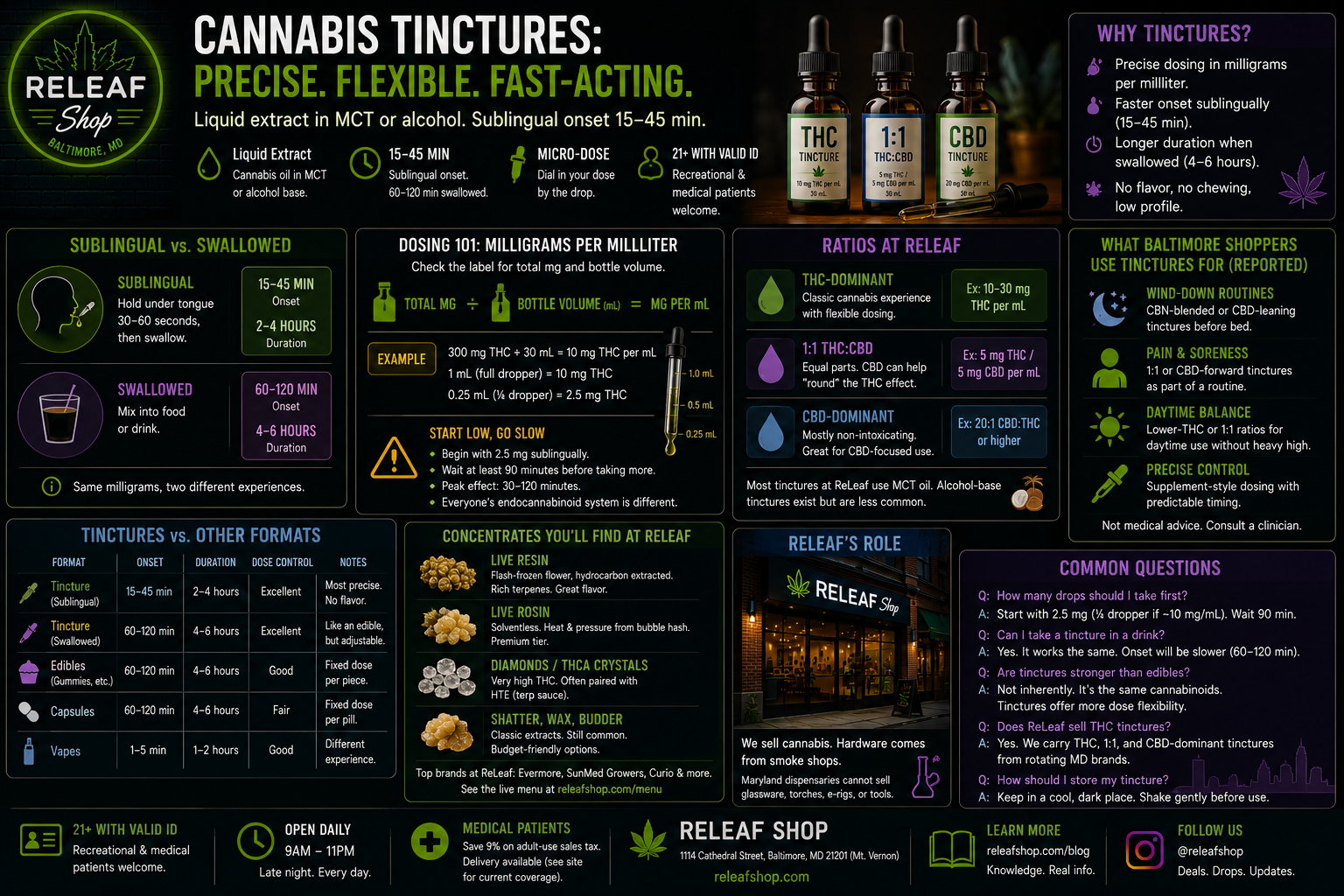
Cannabis tinctures: liquid extract in MCT or alcohol, sublingual onset 15-to-45 min, micro-dose flexibility. THC, 1:1, and CBD-dominant ratios at ReLeaf.

A cannabis tincture is a liquid extract (usually cannabis oil suspended in MCT or alcohol) taken by dropper under the tongue (sublingually) or mixed into food and drinks. Tinctures kick in faster than edibles when used sublingually (15 to 45 minutes versus 60 to 120 minutes for a gummy or baked good) and are easier to micro-dose than most other formats. ReLeaf Shop in Baltimore stocks tinctures from rotating Maryland brands across THC-dominant, balanced 1:1, and CBD-dominant ratios.
A tincture is a liquid cannabis extract carried in a base oil — most commonly MCT (medium-chain triglyceride) coconut oil, sometimes glycerin, occasionally alcohol. The cannabis material is extracted to concentrate the cannabinoids and terpenes, then combined with the carrier oil at a precise dose per milliliter. The product is sold in a small glass bottle with a dropper.
What makes tinctures useful as a format is the precision. A standard Maryland tincture lists the milligrams per milliliter on the label, and most droppers are calibrated so you can take a quarter-milliliter, half-milliliter, or full milliliter dose deliberately. That kind of micro-dosing is hard to do with a gummy or a pre-roll.
The same tincture can produce two different onset windows depending on how you use it:
Sublingual (under the tongue). Hold the dose under your tongue for 30 to 60 seconds before swallowing. The cannabinoids absorb partially through the mucous membranes — bypassing some of the digestive metabolism. Onset is typically 15 to 45 minutes. Effect duration is 2 to 4 hours for most users.
Swallowed (mixed into food or drink). The tincture goes through the full digestive path, like any classic edible. Onset is 60 to 120 minutes. Duration extends to 4 to 6 hours because the liver metabolizes the THC into 11-hydroxy-THC, which is longer-lasting.
Same milligrams, two different experiences. Most experienced tincture users settle into one method based on what they want from the product — sublingual for faster, swallowed for longer.
The label on a Maryland-stocked tincture lists three numbers that matter: total THC in the bottle, total CBD (if any), and the volume of the bottle (usually 15ml or 30ml). The math from there is simple:
Total mg ÷ bottle volume = mg per milliliter.
A 30ml bottle with 300mg of THC is 10mg per milliliter. A full dropper is 1ml = 10mg of THC. A quarter dropper is 2.5mg, which is a meaningfully small starting dose for a first-time tincture user.
For tincture-first cannabis customers, our budtenders usually recommend starting at 2.5mg sublingual, waiting at least 90 minutes, and re-dosing only if the effect is below what was wanted. The micro-dose approach is the practical advantage of the format. Published research on cannabis pharmacology supports the lower-and-slower approach for new users.
The closest neighbors to tinctures in the Maryland retail case:
Edibles (gummies, chocolates, baked goods). Same digestive pathway as a swallowed tincture, with the added factor of food matrix slowing absorption further. Onset 60 to 120 minutes. Dose per piece is fixed; the tincture dose-per-milliliter is more flexible.
Capsules (pills). Same digestive pathway. Dose is fixed per pill, typically 5mg or 10mg of THC. Less micro-dosing flexibility than a tincture but simpler to consume.
Vapes. Different category entirely — onset 1 to 5 minutes, duration 1 to 2 hours. Faster than any tincture but a different experience.
For shoppers who want the "edible feeling" with more dose control, a tincture is the most flexible format. For shoppers who want the longest-lasting cannabis effect, a swallowed tincture or an edible is the answer.
The tincture rotation at ReLeaf typically includes:
THC-dominant tinctures. 10mg to 30mg of THC per milliliter. The standard for a tincture customer who wants the classic cannabis experience with dose control.
1:1 THC:CBD. Equal parts. Common in Maryland tincture lineups; customers report the CBD softens the THC effect, similar to a 1:1 gummy.
CBD-dominant (20:1 or higher). Mostly non-intoxicating. Used by customers who want the regulated-and-tested CBD path. Doctor Solomon's at ReLeaf is one of the most-consistent CBD-forward tincture lines.
MCT vs. alcohol base. Most Maryland tinctures use MCT oil. Alcohol-base tinctures exist but are less common in the retail market. The alcohol base is faster sublingual absorption; the MCT base is easier on the tongue and more popular with customers using the swallow-with-food method.
Paraphrased patterns from budtender conversations, not medical guidance:
Tincture customers often describe wanting a more "clinical" cannabis experience than the gummy aisle — precise dosing, predictable timing, lower-profile consumption (no flavor, no chewing, no smell). The category attracts a higher share of older customers and customers who came to cannabis from the supplement world rather than the recreational-flower world.
Common reported use cases: wind-down before sleep (CBN-blended tinctures), pain-and-soreness routines (1:1 or CBD-leaning), and shoppers who want a long-duration mid-day option that isn't a gummy. Cannabis labels at the dispensary include format and ratio; the rest of the use case is up to the individual.
A liquid cannabis extract carried in a base oil (usually MCT) or alcohol. Sold in a small glass bottle with a calibrated dropper, taken sublingually or mixed into food and drink. Each milliliter of tincture contains a labeled milligram dose of THC and (depending on the SKU) CBD or other cannabinoids.
15 to 45 minutes when taken sublingually (under the tongue, held for 30 to 60 seconds before swallowing). 60 to 120 minutes when swallowed or mixed into food and drink. The sublingual method bypasses some of the digestive metabolism.
Not inherently — both deliver the same cannabinoids. The difference is in dose control. A standard Maryland tincture is sold by milligram-per-milliliter so you can take a 2.5mg dose deliberately; most gummies come in fixed 5mg or 10mg pieces. Per equivalent dose, the experience is similar.
Yes. ReLeaf carries tinctures from rotating Maryland brands across THC-dominant, 1:1, and CBD-dominant ratios. Specific lines change with the Maryland wholesale rotation; check the live menu the day you visit.
Yes. Mixing a tincture into food or a beverage works fine — the dose is the same. The tradeoff is onset time: drinking the tincture follows the slower digestive pathway (60 to 120 minutes) instead of the sublingual pathway (15 to 45 minutes).
Research and regulation: Maryland Cannabis Administration, published cannabis pharmacology research. ReLeaf coverage of related formats: cannabis topicals, RSO guide, edibles guide, and Maryland edibles at ReLeaf.
This post is informational and does not constitute medical advice. Consult a clinician for case-specific questions about cannabis products and your health.