Order Online
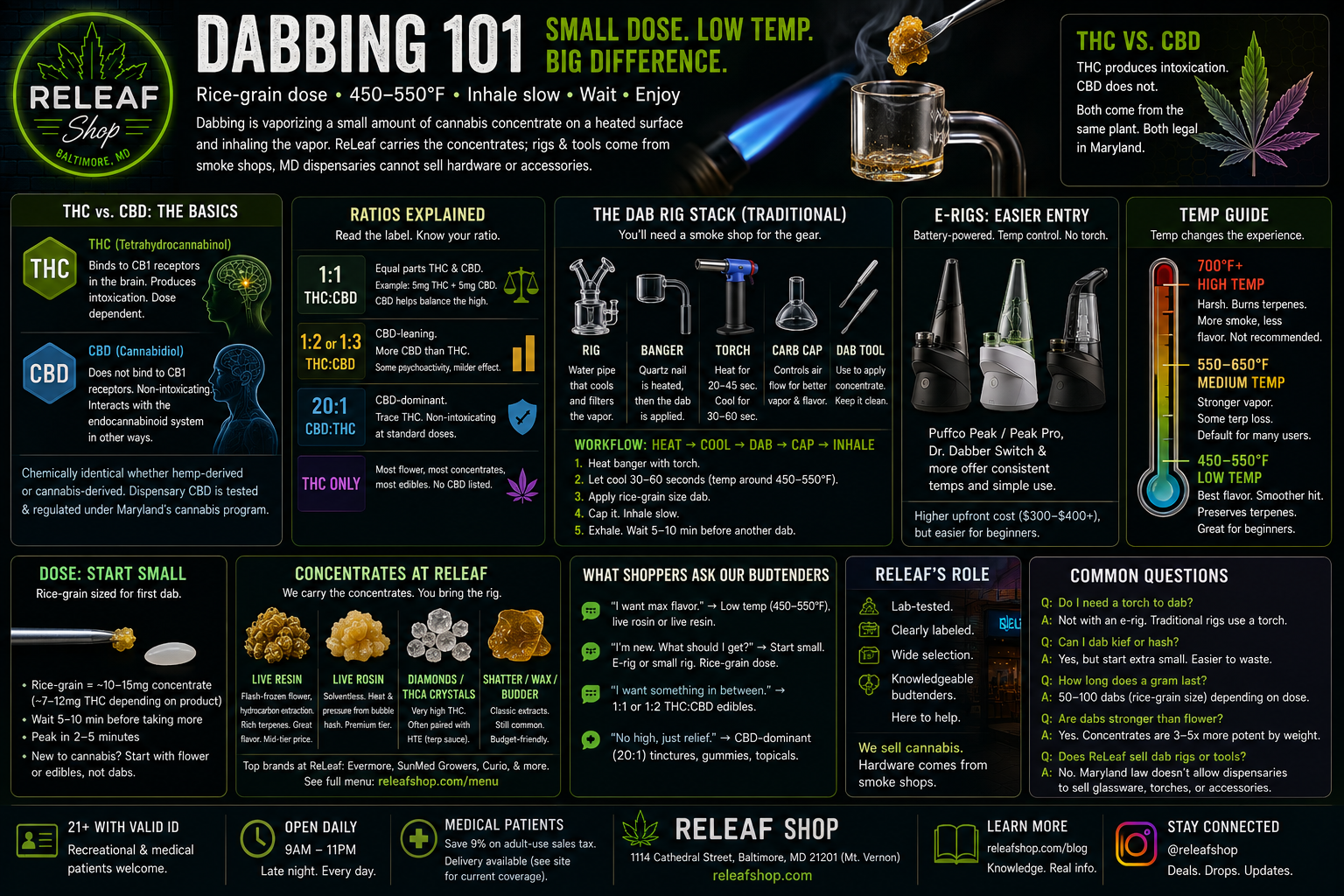
Dabbing 101: rice-grain dose, low temp (450-550°F), traditional rig vs. e-rig. ReLeaf carries the concentrates; the hardware comes from smoke shops.

Dabbing is the act of vaporizing a small portion of cannabis concentrate on a heated surface (a banger, a quartz insert, or an e-rig coil) and inhaling the vapor. A dab for a new user is rice-grain sized, taken at a low temperature (around 450 to 550°F), and inhaled slowly. ReLeaf Shop in Baltimore carries the concentrates, but the rigs and tools are sold at smoke-shop retailers. Maryland dispensaries are not permitted to sell glassware or accessories.
A dab is a small dose of cannabis concentrate vaporized at high temperature. The dose is small because the concentrate is potent — extracts typically test in the 60% to 90%-plus THC range, versus 18% to 30% for most flower. Half a rice grain of live rosin can be roughly equivalent in dose to a full joint of mid-tier flower.
What separates dabbing from a vape cartridge: the cart pre-loads the concentrate into a sealed cartridge designed for low-temperature vaporization via a battery. A dab requires the user to portion the concentrate, heat the surface separately, and time the inhale. The flavor and effect profile are different — dab purists argue the unprocessed extract preserves more terpenes than the cartridge format does. The tradeoff is the learning curve.
Traditional dabbing uses a glass rig (similar to a small water pipe), a quartz banger nail, a butane torch, a carb cap, and a metal dab tool. The full setup runs $80 to $200 depending on the rig quality. Maryland dispensaries do not sell any of this hardware — you'll need a smoke shop.
What each piece does:
Rig. The glass piece that holds water and routes the vapor. Smaller is usually better for dabs; the smaller chamber concentrates the vapor.
Banger / quartz nail. The heated surface where the concentrate vaporizes. Heated to temperature with a torch, then the concentrate is applied.
Torch. Butane, typically. The heat source. Used for 20 to 45 seconds depending on banger size, then the banger cools for 30 to 60 seconds before the concentrate is applied — the "wait time" is the part most new dabbers skip.
Carb cap. Sits over the banger after the concentrate is applied. Restricts airflow so the vapor concentrates and the user pulls a richer hit.
Dab tool. Small metal or quartz tool for applying the concentrate to the banger. Don't use anything plastic — heat melts it.
E-rigs solve the temperature-control problem of the traditional setup by using a battery-heated coil with a digital temperature display. The Puffco Peak (and Peak Pro), Dr. Dabber Switch, and similar units have replaced the torch-and-banger workflow for many new dabbers.
E-rigs cost more upfront ($300 to $400 for the established models) but skip the torch, the wait time, and most of the temperature guesswork. For a first-time dabber who's not committed to the hobby yet, an e-rig is often the more forgiving entry point. Maryland dispensaries don't sell these either; smoke shops carry the major brands.
The temperature of the dab changes the experience meaningfully:
Low temp (around 450 to 550°F). Preserves more of the terpenes. The flavor is fuller, the hit is smoother, and the vapor production is lower. Most experienced dabbers prefer the low-temp end. The tradeoff is that the dose feels less aggressive, which some users misinterpret as "the dab didn't work" and re-up before the first dose hits.
Medium temp (around 550 to 650°F). The default for most casual dabbers. Stronger vapor production, slightly less terpene preservation than the low end.
High temp (above 700°F). Combusts the concentrate rather than vaporizing it. Harsher, more potent feeling, fewer of the terpenes, more of the burn. Most experienced dabbers consider high-temp dabs a waste of concentrate. The "smoky" dab is the high-temp version.
For a first-time dabber, start at the low end. The dose is still meaningful at 450°F; the smoothness and flavor are what makes the experience worth it.
The single most-common new-dabber mistake is doing too much. Concentrates are 3 to 5 times more potent than flower by weight, and the inhale-and-effect window is faster than an edible. A rice-grain-sized dab (roughly 10 to 15mg of concentrate, somewhere around 7 to 12mg of THC depending on the extract) is the recommended starting dose for someone who's smoked flower before but not dabbed.
For someone who hasn't smoked cannabis before at all, dabbing is not the recommended starting format. The dose-to-effect ratio is steeper than flower or edibles, and the first-time learning curve is harder.
Titrate by waiting at least 5 to 10 minutes between dabs before deciding whether to take another. The peak effect comes in the first 2 to 5 minutes of inhalation; if you wait the full 10, you'll know.
ReLeaf's role in the dabbing setup is concentrate. Maryland regulations restrict dispensaries to cannabis products only; glassware, torches, e-rigs, and dab tools are not part of that license. Our cannabis concentrates guide walks through the format options.
The concentrate types stocked most consistently at ReLeaf:
Live resin. Flash-frozen flower, hydrocarbon extraction. Preserves more terpenes than distillate. Mid-tier of the dab-concentrate menu by price. Brands rotate.
Live rosin. Solventless. Heat-and-pressure extraction of bubble hash. The premium tier in most Maryland menus.
Diamonds / THCA crystals. Highest-THC-percentage concentrate. Often paired with HTE (high-terpene extract) in dabs for flavor.
Shatter, wax, and budder. Older-school distillate-style concentrates. Less common than live resin or rosin at ReLeaf but still on the shelf in rotation.
The live resin vs. live rosin post goes deeper into the extraction-method comparison. Brand-side, the consistent dabbing-concentrate names at ReLeaf include Evermore Cannabis Company and other Maryland craft extractors.
Rice-grain sized — roughly 10 to 15mg of concentrate. For someone who's smoked flower regularly but not dabbed, that's the recommended starting dose. Wait 5 to 10 minutes before deciding whether to take a second.
Dab pens (smaller portable units with a heated coil) are the simplest entry point but produce less flavor and vapor than a proper rig or e-rig. For occasional dabbing, a pen is fine. For someone planning to dab regularly, a Puffco Peak-style e-rig or a traditional banger-and-torch setup will give a meaningfully better experience.
Start in the 450 to 550°F range. Low-temp dabs preserve more of the terpenes and produce a smoother hit. Higher temperatures combust more of the concentrate, which is harsher and wastes terpenes without much potency gain.
No. Maryland dispensaries are restricted to cannabis products and are not permitted to sell glassware, torches, or accessories. ReLeaf carries the concentrates; the hardware comes from a separate smoke-shop retailer.
A gram of live resin at ReLeaf typically runs $35 to $55 before tax, depending on brand and tier. That gram yields roughly 50 to 100 rice-grain-sized dabs. By per-dose cost, dabs are usually cheaper per equivalent THC dose than flower, especially when comparing to lower-percentage flower in the $40-per-eighth range.
Research and regulation: Maryland Cannabis Administration on concentrate regulations. ReLeaf coverage of concentrates: cannabis concentrates guide, live resin vs. live rosin, RSO at ReLeaf, and cannabis brands.